
Average Gutter Installation Costs in Colorado
Most Colorado homeowners pay $1,650 to $2,750 for a complete gutter installation on a 150-250 linear foot system. That's the real-world range for aluminum seamless gutters with downspouts and basic labor — the setup that handles 80% of residential jobs along the Front Range.
Single-story ranch homes in Aurora or Lakewood typically land at the lower end ($1,200-$1,800), while two-story homes with complex rooflines in Boulder or Colorado Springs push toward $2,500-$3,500. Add a third story, multiple valleys, or premium materials like copper, and you're looking at $4,000-$7,000+.
The national average sits around $1,500-$2,400, but Colorado's labor market runs 15-20% higher than Midwest states. Our shorter installation season (mountain areas essentially shut down November through March) compresses demand into six months, keeping hourly rates elevated even during shoulder seasons.
Material Costs vs Labor Breakdown
Materials account for 40-50% of your total cost. A 200-foot aluminum seamless system runs $800-$1,200 in raw materials, while labor adds another $850-$1,550 depending on roof height, pitch accessibility, and fascia condition.
Here's where Colorado pricing splits from national patterns: fascia board replacement happens on 30-40% of installations due to our freeze-thaw cycling. That bentonite clay soil along the Front Range shifts foundations, which torques rooflines and rots fascia boards faster than in stable-soil regions. Budget an extra $6-$12 per linear foot if your fascia needs work before new gutters go up.
Mountain communities above 8,000 feet pay a 20-35% premium for everything.
Getting materials to Breckenridge or Estes Park costs more, installation windows shrink to May-October, and snow load requirements demand heavier-gauge hangers and reinforced downspouts.
Quick Cost Factors for Colorado Gutter Installation:
- Single-story homes (Front Range): $1,200-$1,800
- Two-story homes (Front Range): $2,500-$3,500
- Mountain communities premium: +20-35%
- Fascia replacement add-on: $6-$12/linear foot
- Materials portion: 40-50% of total cost
- Peak installation season: May-September (book 4-8 weeks ahead)
Material Options and Their Colorado-Specific Pricing
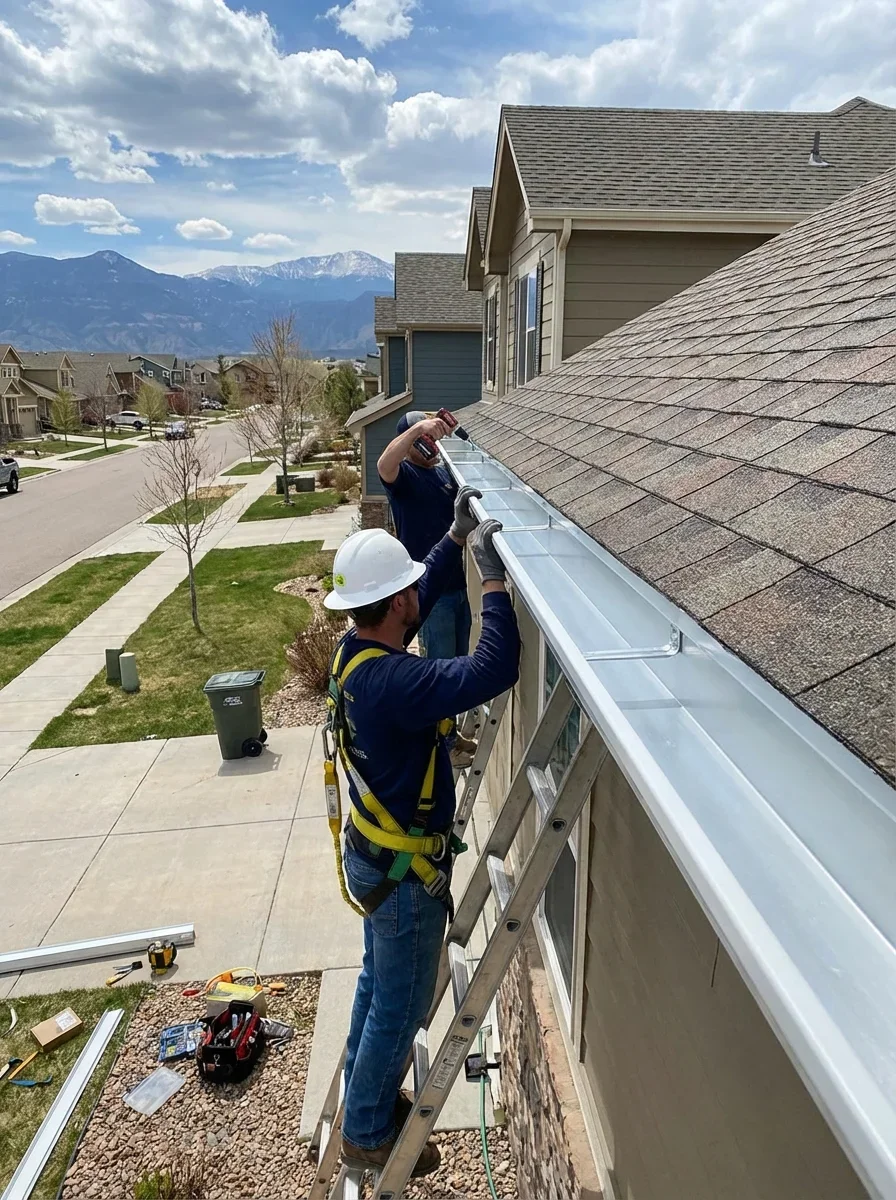
Aluminum seamless gutters dominate 75% of Colorado installations for good reason. They flex during hail impacts rather than denting permanently, resist UV degradation better than vinyl, and handle our temperature extremes without cracking. Expect $9-$18 per linear foot installed for 5-inch K-style in .027-.032 gauge.
Vinyl costs less upfront ($5-$9 per foot) but cracks in subzero temperatures and becomes brittle under our intense UV exposure. Most contractors won't warranty vinyl installations in Colorado. It's penny-wise and pound-foolish for our climate.
Copper runs $25-$50+ per linear foot but lasts 50+ years and develops that signature patina mountain homeowners love. You'll see copper gutters on historic Denver bungalows and high-end Aspen properties where aesthetics justify the premium. The material doesn't corrode, never needs painting, and survives hail that would demolish aluminum.
Steel (galvanized or stainless) costs $12-$30 per foot and handles heavy snow loads better than aluminum. Mountain homes use it where snowslides off metal roofs and impacts gutters with force. The downside: steel dents from hail and needs rust maintenance every 5-7 years unless you opt for stainless, which doubles the price.
Seamless vs Sectional Systems
Seamless gutters cost $900-$1,250 more than sectional systems on a typical 200-foot installation, but that premium buys you 60-70% fewer leak points. Sectional gutters join every 10 feet with seams that crack during freeze-thaw cycles — exactly the failure mode that plagues Colorado installations.
Contractors form seamless gutters on-site using portable rolling machines, cutting runs up to 50+ feet without joints.
You'll only have seams at inside and outside corners, dramatically reducing the leak risk from thermal expansion and contraction during those 60°F daily swings.
Sectional systems made sense 30 years ago when seamless equipment was rare. Today, nearly every reputable Colorado contractor owns a seamless gutter machine. Choosing sectional to save $1,000 upfront typically costs you $400-$800 in repairs over the first decade.
| Feature | Seamless Gutters | Sectional Gutters |
|---|---|---|
| Upfront Cost (200 ft) | $1,800-$3,000 | $900-$1,750 |
| Leak Points | Only at corners (4-8 seams) | Every 10 feet (20+ seams) |
| Freeze-Thaw Durability | Excellent — minimal seam failure | Poor — seams crack within 3-5 years |
| 10-Year Maintenance Cost | $200-$400 | $600-$1,200 |
| Best For | Colorado's climate extremes | Limited budgets, temporary solutions |
What Drives Cost Variations Across Colorado
Your zip code matters more than you'd expect. Denver metro contractors charge $4.50-$6.50 per linear foot for labor, while Grand Junction or Pueblo runs $3.75-$5.25. That's not about skill. It's market dynamics. Front Range demand stays high year-round due to hail damage, while Western Slope contractors compete harder for fewer jobs.
Roof pitch and height add 25-50% to labor costs once you exceed a 6/12 pitch or need scaffolding for second-story work. A one-story ranch with 4/12 pitch costs $1,650 for 180 feet. That same house with 8/12 pitch and two stories hits $2,850. Safety equipment, fall protection, and slower installation pace all drive the difference.
Fascia condition determines whether you're paying for gutter installation alone or fascia replacement too.
Rotted fascia boards need replacement before gutters go up — you can't anchor hangers to soft wood. That adds $6-$12 per linear foot depending on wood type (pine vs cedar) and accessibility. Most Denver-area homes built in the 1970s-1990s need at least partial fascia work.
Removal and Disposal Costs
Contractors charge $100-$200 per downspout for removing and hauling away old gutters. That's on top of installation pricing. A typical home with 4-6 downspouts adds $400-$1,200 to your quote just for teardown.
Some contractors include removal in their base price; others itemize it separately. Ask specifically how removal is priced when comparing bids. The cheapest quote might not include hauling, leaving you with 200 feet of aluminum scrap to dispose of yourself.
Downspout relocation or extension adds $75-$150 per downspout. Colorado's expansive clay soil means you need downspouts directing water at least 6-10 feet from your foundation. Closer than that and you're inviting basement water intrusion when the soil swells.
Gutter Guards and Protection Systems
Gutter guards cost $6-$11 per linear foot installed, adding $1,200-$2,200 to a standard 200-foot system. That seems steep until you factor in our cottonwood and aspen trees dropping debris year-round, plus the safety risk of climbing ladders every fall to clear leaves.
Micro-mesh guards (brands like LeafFilter or Raptor) handle pine needles and aspen leaves better than the older screen-style guards. They cost more ($8-$11 per foot) but actually work in Colorado's tree-dense neighborhoods. Screen guards clog with cottonwood fluff by mid-June.
Skip guards entirely if you have a clear lot with minimal tree cover.
You're paying for protection you don't need. But if you've got mature trees within 30 feet of your roofline, guards pay for themselves in 4-6 years through eliminated cleaning costs and reduced downspout clogs.
One contractor complaint you'll hear: gutter guard salespeople quote the guards alone and add installation labor later as a "processing fee." Get the installed price upfront, not materials-only pricing that jumps 40% when they show up to measure.
Hidden Costs and Add-Ons to Expect
Downspout extensions cost $15-$35 each but prevent thousands in foundation damage from water pooling against your basement walls. Colorado's clay soil expands when saturated, pushing against foundations and cracking walls. Every downspout should drain at least 6 feet away — not into a splash block that dumps water 18 inches from your foundation.
Fascia board painting or wrapping adds $3-$6 per linear foot after installation. Raw wood fascia rots faster at altitude due to UV exposure and moisture cycling. Wrapping it with aluminum coil stock during gutter installation costs $600-$1,200 extra but extends fascia life by 15-20 years.
Hanger upgrades matter in mountain communities and anywhere you get heavy snow.
Standard spike-and-ferrule hangers (spaced 24 inches apart) fail under snow load on steep roofs. Hidden hangers spaced 16 inches apart cost $1.50-$2.50 more per linear foot but prevent the sagging you see on every third house in mountain neighborhoods after a 30-inch snowstorm.
Heat cable installation runs $8-$15 per linear foot and prevents ice dams on north-facing rooflines where snow doesn't melt between storms. You'll see these on every other home in Boulder's foothills neighborhoods. They're not optional if you want ice dam prevention rather than annual $1,200 repair bills.
Permit and Inspection Fees
Most Colorado municipalities don't require permits for gutter installation alone, but if you're replacing fascia boards or modifying roofline drainage patterns, expect $75-$150 in permit costs. Denver, Colorado Springs, and Aurora have varying rules — your contractor should know local requirements.
HOA approval can delay projects 2-6 weeks in communities with architectural review boards.
Mountain subdivisions often restrict gutter colors to specific earth tones or require concealed hangers for aesthetic reasons. Budget time for approval, not just money.
Pro Tip for Mountain Homeowners: If your property sits above 8,000 feet, always request 6-inch gutters with 3x4-inch downspouts regardless of roof size. A 2,000-square-foot roof releasing snowmelt during a spring Chinook event will overwhelm standard 5-inch systems within hours, sending waterfalls into window wells and causing foundation damage that costs far more than the $400-$600 upfront gutter upgrade.
Size and Capacity Considerations for Colorado Homes
Standard 5-inch K-style gutters handle most Colorado roofs up to 1,200 square feet of drainage area. That works for ranch homes and simple rooflines, but our intense summer thunderstorms drop 1-2 inches per hour during peak intensity — more than 5-inch gutters can process on large roof planes.
Six-inch gutters cost $2-$4 more per linear foot but prevent overflow on two-story homes or roofs with multiple valleys converging into single gutter runs. If your roof drains 1,500+ square feet into one gutter section, size up. Overflow during storms defeats the entire purpose of having gutters.
Downspout sizing follows the same logic.
Standard 2x3-inch downspouts choke during heavy rain if they're handling more than 600 square feet of roof area. Upgrading to 3x4-inch downspouts costs $8-$12 more per downspout but prevents the backup and overflow you see on undersized systems during our June-August hail season.
Mountain homes above 7,000 feet need 6-inch gutters almost universally due to snow load and melt volume. A 2,000-square-foot roof releasing snowmelt during a spring Chinook event overwhelms 5-inch gutters within hours, sending waterfalls over the edges and into window wells.
Labor Factors That Impact Your Final Bill
Installer experience matters more in Colorado than most states because our climate punishes bad workmanship fast. Improperly sloped gutters pool water that freezes and expands, cracking seams within one winter. Hangers spaced too far apart sag under snow load by the first February.
Licensed contractors (where local licensing exists — remember, Colorado has no state roofing license) charge $65-$95 per hour for labor, while unlicensed handymen run $35-$50. That gap narrows when you factor in callbacks for leaks, improper slope, or fascia damage from wrong fastener placement.
Installation speed varies with crew size and experience. A two-person crew installs 150 feet of seamless gutters in 4-6 hours on a straightforward ranch, while complex rooflines with multiple inside corners take 8-10 hours. Rush jobs during peak season (May-September) sometimes cost 15-20% more because you're paying crews to work weekends or evenings.
Access challenges add cost.
Homes built into hillsides (common in Golden, Morrison, and foothills communities) require scaffolding or lift rentals that add $400-$800 to standard quotes. If contractors can't park their seamless gutter machine within 50 feet of your roofline, material handling time doubles.
Storm Chaser vs Local Contractor Pricing
Storm chasers flood Colorado after major hail events, offering quotes 20-30% below local contractors. They're usually running insurance restoration volume plays — high volume, thin margins, quick turnarounds. That works if they're legitimate contractors, but you'll find unlicensed outfits from Texas or Oklahoma who disappear before warranty issues surface.
Local contractors cost more upfront but stand behind their work for years, not weeks.
A Fort Collins contractor isn't vanishing to Kansas after installing your gutters. They'll return for adjustments during the first year if slope needs tweaking or a hanger loosens.
Check licensing at your municipality's building department (Denver at denvergov.org, Colorado Springs at coloradosprings.gov, etc.) and verify liability insurance. Colorado doesn't require state licensing, but most cities mandate contractor registration. Storm chasers often skip local registration entirely.
Seasonal Pricing and Availability
May through September is peak season for gutter installation, with contractors booking 4-8 weeks out after major hail storms. Pricing doesn't fluctuate wildly, but availability does. Expect delays during this window unless you book early.
October and November offer better availability before mountain contractors shut down for winter. Front Range contractors work year-round but slow down December through February when overnight temps stay below freezing for weeks. You can install gutters in winter (materials don't care about temperature), but labor costs rise 10-15% because crews work slower in cold conditions.
March and April see scheduling open up again as contractors gear up for peak season.
This is the window for negotiating slightly better pricing — contractors want their calendars filled before the hail season rush begins in June.
Mountain communities have rigid installation windows (May-October) driven by snow cover and access, not just temperature. Getting equipment to a home at 9,500 feet in January isn't happening regardless of price.
When Repair Makes More Sense Than Replacement
If less than 30% of your gutter system needs work, repair typically costs less than full replacement. A 40-foot section replacement runs $400-$700 including labor, while full replacement on a 200-foot system costs $1,800-$2,800.
Sagging gutters from failed hangers cost $150-$350 to fix if the gutter material itself is sound. Contractors add hangers (spaced 16 inches apart instead of 24 inches) and re-pitch the run to restore proper drainage. That's a half-day job, not a multi-day replacement.
Leaking seams on older sectional gutters can be sealed with high-quality butyl sealants for $8-$15 per seam, but that's a temporary fix.
If you're sealing seams every 2-3 years, you're throwing good money after bad. Replace the system with seamless and eliminate the problem permanently. Colorado's freeze-thaw cycling reopens sealed seams faster than in milder climates.
Gutter repair makes sense when the system is under 10 years old and damage is localized. Older than that, especially if you're seeing multiple failure points, replacement delivers better long-term value.
Insurance Coverage for Gutter Damage
Hail damage to gutters is covered under most Colorado homeowners policies, but you'll pay your wind/hail deductible (often 1-2% of home value, so $5,500-$11,000 on a $550,000 home). If the only damage is gutters, filing a claim for a $2,200 repair doesn't make financial sense when your deductible is $6,000.
Wind-torn gutters from Chinook events or tornadic storms typically qualify for claims.
Document damage with photos immediately and get a contractor inspection within 72 hours. Most policies require prompt damage notification.
Insurance companies often approve gutter replacement as part of larger roof claims after hail storms. If you're filing for storm damage roof repair and the gutters show denting or separation, request inclusion in the scope. Adjusters sometimes overlook gutter damage unless you specifically point it out.
Don't sign contracts with "we'll handle your insurance claim" contractors until you verify their legitimacy. Insurance claim assistance from licensed professionals helps, but storm chasers who pressure you to sign before the adjuster visits are red flags.
Getting Accurate Quotes: What to Request
Request itemized quotes showing materials, labor, removal, disposal, and any add-ons separately. Lump-sum quotes hide where your money goes and make comparing bids impossible. You want to see: seamless aluminum 5-inch K-style, .032 gauge, 200 linear feet at $X per foot; labor at $X; removal at $X; downspout extensions at $X per unit.
Ask about hanger type and spacing.
Hidden hangers spaced 16 inches apart cost more than spike-and-ferrule at 24 inches, but they perform better long-term in Colorado conditions. If a quote doesn't specify hanger details, it's incomplete.
Verify fascia condition before signing. Contractors should inspect fascia during measurement appointments and note any replacement needs in the quote. Discovering rotted fascia on installation day leads to change orders that inflate costs 30-40%.
Get installation timelines in writing, especially if you're booking during peak season. "We'll install in 4-6 weeks" doesn't help if you need gutters before monsoon season starts. Pin down specific dates or at least a guaranteed two-week window.
Material Warranties and Workmanship Guarantees
Aluminum seamless gutters carry 20-year to lifetime material warranties from manufacturers, but that doesn't cover installation defects. Contractors should warranty their workmanship separately for 2-5 years minimum. That covers leaks from improper sealing, sagging from inadequate hangers, and detachment from failed fasteners.
Copper gutter warranties run 40-50 years on materials because the metal outlasts most homes. Labor warranties stay the same (2-5 years) regardless of material choice.
Gutter guard manufacturers offer separate warranties (10-25 years) but often require professional installation to activate coverage.
DIY guard installation voids most warranties, and you'll see why when cottonwood fluff clogs a poorly installed screen within one season.
Read warranty exclusions carefully. Most don't cover damage from ice dams, snow load exceeding design specs, or impact from falling tree branches. Colorado's hail is typically covered under material warranties but excluded from labor warranties — meaning the contractor won't pay to replace gutters dented by hail after installation.
Regional Material Performance Data
Aluminum's flexibility saves it during hail storms. A 1.5-inch hailstone dents aluminum but rarely cracks it, while vinyl shatters and steel dents permanently. Colorado's hail frequency (7+ significant events per year along the Front Range) makes aluminum the clear winner for most installations.
UV exposure at 5,280+ feet degrades all materials faster than at sea level. You're getting 50% more UV radiation in Denver than in Houston. Vinyl becomes brittle within 8-10 years here vs 15-20 years in low-altitude climates. Aluminum develops surface oxidation but maintains structural integrity for 20+ years.
Freeze-thaw cycling kills sectional gutter seams faster in Colorado than anywhere outside the Upper Midwest.
Water infiltrates seam gaps, freezes overnight, expands, and cracks the joint. That cycle repeats 50-80 times per winter along the Front Range, while coastal climates see 5-10 cycles annually.
Copper develops patina faster at altitude due to UV intensity and low humidity. That distinctive green-blue color appears within 3-5 years in Colorado vs 7-10 years in humid climates. Some homeowners love it; others prefer the bright copper look and apply clear sealants to slow patina formation.
DIY vs Professional Installation Cost Analysis
Materials for a DIY seamless gutter installation run $800-$1,200 for 200 feet, but you'll need a seamless gutter machine (rental: $200-$300/day or purchase: $2,000-$4,000). Most homeowners can't justify buying equipment for one job, and rental machines require practice to operate without creating wavy runs.
Sectional gutter DIY costs $600-$900 in materials and needs only basic tools (drill, level, tin snips, hacksaw).
Installation takes a full weekend for beginners on a straightforward ranch home. But remember those seam failure rates — you're saving $800-$1,200 upfront to install an inferior system that costs more long-term.
Proper pitch (1/4 inch per 10 feet toward downspouts) requires precision most DIYers don't achieve on first attempts. Too little pitch creates standing water that breeds mosquitoes and freezes; too much pitch looks awful and concentrates flow, causing erosion at downspout discharge points.
Professional installation removes liability risk.
Fall injuries from ladder accidents cost far more than the $1,200 you save attempting DIY. Colorado contractors carry liability insurance and workers' comp — you don't.
Choosing the Right Contractor for Colorado Conditions
Look for contractors who discuss Colorado-specific challenges during estimates. If they're not mentioning fascia condition, freeze-thaw cycles, hail resistance, or proper pitch for snow load, they're either inexperienced or don't care about quality.
Ask how they handle expansive clay soil drainage. Downspouts need to discharge 6-10 feet from foundations along the Front Range, not into splash blocks 2 feet away. Contractors familiar with bentonite soil issues will mention this unprompted.
Request references from installations done 5+ years ago and follow up.
A three-year-old installation hasn't survived enough freeze-thaw cycles to prove quality. Systems that leak or sag by year five reveal installation shortcuts (too few hangers, improper seam sealing, inadequate pitch).
Verify they're using hidden hangers or commercial-grade spike systems, not the cheap box-store spike-and-ferrule sets that pull out during the first heavy snow. Quality hangers cost $2-$3 each vs $0.50 for cheap versions — that $300-$500 material difference prevents $2,000 in sag-related damage.
Colorado-specific questions to ask:
- What gauge aluminum do you use? (.027 minimum, .032 preferred for hail resistance)
- How do you account for snow load in hanger spacing?
- Do you wrap or paint fascia, or install gutters on raw wood?
- What's your process for homes on expansive clay soil?
- How do you handle downspout discharge away from foundations?