
Material Costs by Metal Type
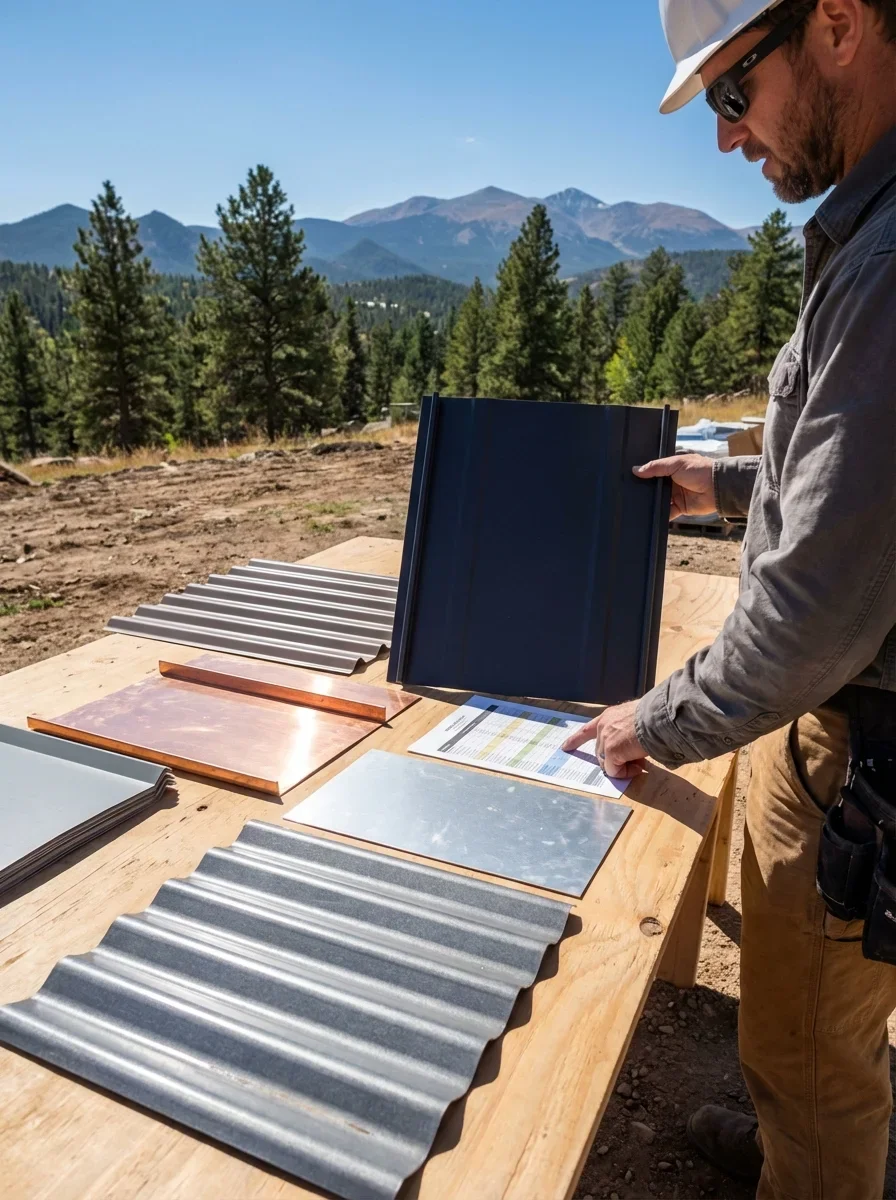
The metal you choose drives 40-50% of your total project cost. Colorado contractors stock five main types, each with different performance profiles for hail resistance, UV fade, and snow load capacity.
Standing seam steel runs $450-$650 per square (100 sq ft) for 24-gauge material. This is the most popular choice along the Front Range. Concealed fasteners mean no exposed nail holes for hail to exploit, and the vertical ribs shed snow efficiently. 26-gauge (thinner) steel drops to $350-$500 per square but dents more easily in 1.5+ inch hail.
Aluminum costs $550-$800 per square for .032-inch thickness. It weighs half what steel weighs, making it ideal for older Denver bungalows with undersized roof framing. Aluminum won't rust in Colorado's high-altitude UV environment, but it dents more readily than steel.
Mountain homeowners in wildfire-risk zones often choose aluminum with Kynar 500 coatings that resist heat better than painted finishes.
Stone-coated steel (brands like Decra and Metro) ranges $700-$950 per square. These systems use a granulated stone finish bonded to 26-gauge steel, creating a textured profile that mimics traditional shingles or tile. The stone coating absorbs hail impact better than smooth metal, and the look satisfies HOAs that ban exposed metal. Insurance companies classify stone-coated steel as Class 4 impact-resistant, unlocking premium discounts of 15-28%.
Copper starts at $1,400 per square and climbs past $2,000 for 16-ounce material. You'll see copper on historic Capitol Hill Victorians and high-end mountain properties where 50+ year lifespan justifies the cost. Copper develops a protective patina in 7-10 years (faster in Colorado's intense UV) that stops corrosion permanently.
No paint means no fade.
Corrugated metal (exposed fastener panels) costs $250-$400 per square. This is bare-bones metal roofing: wavy panels screwed directly through the face with rubber-gasketed fasteners. It's common on agricultural buildings and budget mountain cabins, but not recommended for primary residences. Exposed fasteners are the first point of failure in freeze-thaw cycling. Gaskets crack, screws loosen, and leaks develop within 10-15 years.
| Metal Type | Cost Per Square | Best For | Hail Resistance | Lifespan |
|---|---|---|---|---|
| Standing Seam Steel (24-ga) | $450-$650 | Front Range homes, snow load areas | Excellent | 40-50 years |
| Aluminum (.032") | $550-$800 | Older homes, wildfire zones | Good | 40+ years |
| Stone-Coated Steel | $700-$950 | HOA compliance, Class 4 rating | Excellent | 30-40 years |
| Copper (16-oz) | $1,400-$2,000+ | Historic homes, premium properties | Excellent | 50+ years |
Gauge and Thickness Considerations
Thicker metal costs more but survives Colorado's hail environment longer. The difference between 26-gauge and 24-gauge steel is $100-$150 per square, but 24-gauge withstands 2-inch hail without permanent denting.
Several homeowners report that 29-gauge panels (often sold as "residential grade") dimpled badly in a single severe hailstorm, requiring insurance claims just months after installation.
Aluminum thickness follows a different scale: .032-inch is standard, .040-inch is premium. The jump costs $150-$200 per square but matters if you're in a high-hail corridor like the I-25 corridor from Castle Rock to Fort Collins.
Labor and Installation Costs in 2026
Labor accounts for 50-60% of a metal roofing project in Colorado, and costs diverge sharply from national averages. Skilled metal roof installers charge $8-$14 per square foot in the Denver metro area. A 2,000-square-foot roof runs $16,000-$28,000 in labor alone.
Mountain installations above 8,000 feet add 25-40% to labor costs.
Contractors factor in shortened work seasons (May through October only), limited equipment access, and higher insurance rates for high-elevation work. Transporting materials up narrow canyon roads adds fuel surcharges, and crews often work half-day shifts in thinner air where fatigue sets in faster.
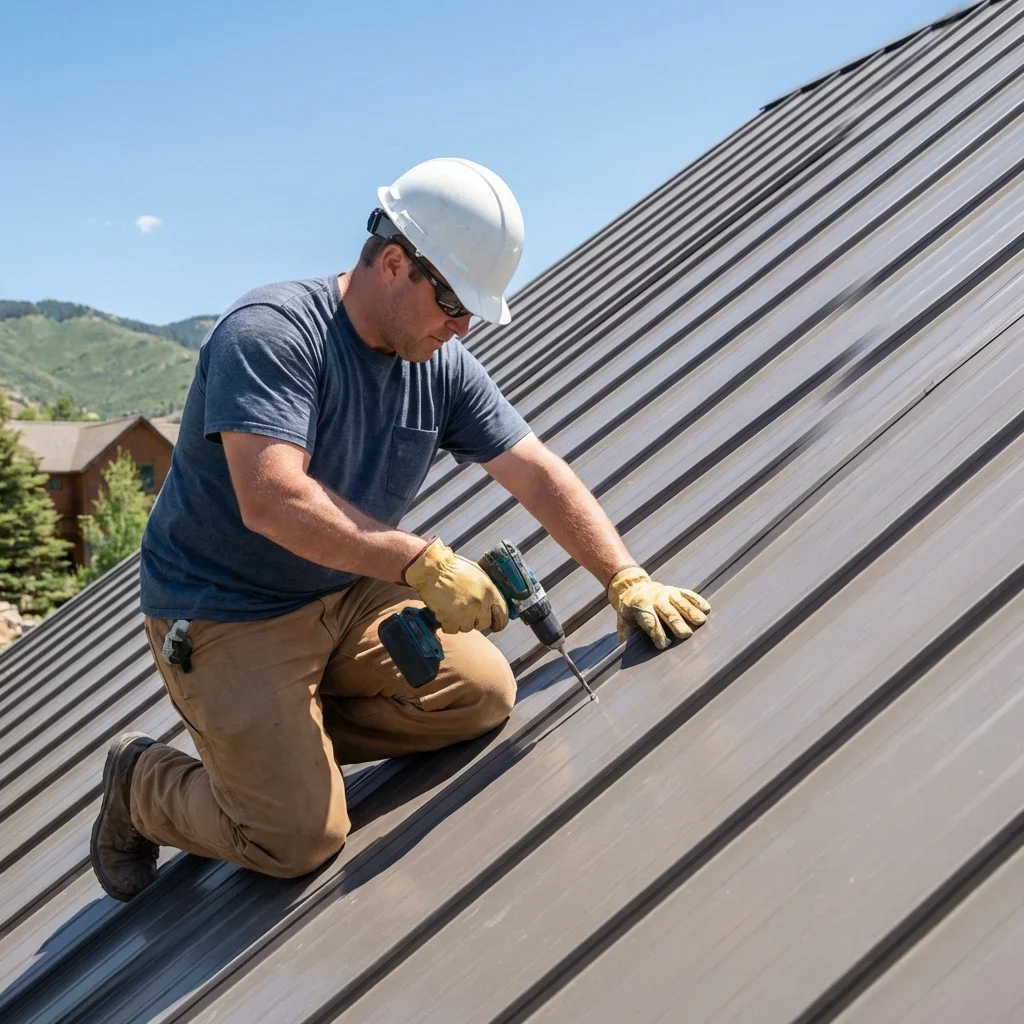
Standing seam metal requires specialized tools and training. Panels must be mechanically seamed on-site using portable seaming machines. Each seam runs the full length of the roof from ridge to eave. Installers with Metal Construction Association (MCA) certification typically charge at the higher end of the range, but they understand Colorado's wind uplift requirements and snow load calculations.
An improperly seamed panel can peel off in 80 mph Chinook winds.
Tear-off and disposal add $150-$250 per square if you're replacing an existing roof. Most Colorado homes built before 1990 have one or two layers of asphalt shingles that must come off before metal installation. Homes with T-lock shingles (discontinued style from the 1980s-90s) sometimes require deck repairs where hail penetrated and rotted the sheathing. Add $400-$600 per damaged section.
Deck Preparation and Underlayment
Colorado's freeze-thaw cycles and expansive clay soil movement mean your roof deck probably isn't perfectly flat. Metal roofing exposes every dip and bow.
Contractors charge $3-$6 per square foot to plane high spots, sister sagging rafters, or replace rotted OSB sheathing. Several homeowners wish they'd budgeted for this. One reported an additional $3,200 to correct deck irregularities that weren't visible until the old shingles came off.
Underlayment requirements differ from asphalt roofing. You need a high-temperature synthetic underlayment rated for 250°F+ because metal panels trap heat and cheap felt paper degrades in 5-10 years. Quality synthetic underlayment (GAF Deck-Armor, Grace Tri-Flex) costs $80-$120 per square.
Some contractors cut corners here. Insist on seeing the product labels before installation begins.
Ice and water shield goes along all eaves, valleys, and penetrations. Colorado building code requires ice barrier extending 24 inches inside the exterior wall line in climate zones 5 and above. Mountain properties need coverage up to 36 inches. Budget $150-$200 per square for ice barrier material and labor.
Roof Complexity and Design Factors
A simple gable roof with 4:12 pitch costs substantially less than a multi-plane hip roof with dormers and skylights. Complexity drives labor hours, and metal roofing is less forgiving than asphalt when it comes to valleys, transitions, and penetrations.
Valleys require custom flashing fabricated on-site. Standing seam valleys use open or closed configurations depending on snow load. Open valleys with 24-inch-wide pans handle heavy snowmelt better than closed valleys where panels meet at a crimp. Expect $85-$140 per linear foot for valley fabrication and installation.
Penetrations (chimneys, vent pipes, skylights) need custom-cut boot flashings or pan flashings. Each penetration adds $150-$300 in labor.
Colorado's altitude and intense UV exposure accelerate rubber boot degradation, so many contractors now use metal pipe flashings with EPDM collars that last 25+ years instead of cheap neoprene boots that crack in 7-10 years.
Pitch matters for both material and labor. Roofs under 3:12 pitch require double-lock standing seam systems with sealed seams instead of snap-lock systems. The labor premium runs 15-25%. Roofs over 7:12 pitch need additional safety equipment and scaffolding (add 10-20% to labor costs).
Many Denver-area bungalows and Victorians have 8:12 to 12:12 pitches that look great but complicate installation.
Steep-slope work also requires more material because panels must overlap further to prevent wind-driven rain infiltration. A 10:12 pitch roof uses 8-12% more material than a 4:12 roof covering the same square footage.
Permits, Inspections, and Code Compliance
Most Colorado municipalities require permits for metal roof installations, and permit costs aren't trivial. Denver charges 0.6% of project value with a minimum $100 fee. A $35,000 metal roof job costs $210 in permits. Colorado Springs uses a tiered structure starting at $150 for roofs under 2,000 square feet.
Boulder adds sustainability surcharges for projects that don't meet energy efficiency thresholds.
Unpermitted work voids manufacturer warranties and complicates future insurance claims. If you file a hail damage claim two years after installation and the adjuster discovers no permit was pulled, your insurance company can deny the claim based on code violations.
Critical Warning: Unpermitted metal roofing installations void manufacturer warranties and give insurance companies grounds to deny future hail damage claims. Always verify your contractor has pulled permits before work begins—check your municipal building department website to confirm.
Colorado adopted the 2021 International Building Code and International Residential Code with state amendments. Key requirements for metal roofing:
- Wind uplift ratings appropriate for local wind zones (Denver is 115 mph, mountain communities range from 115-140 mph)
- Snow load calculations for mountain areas (40-60 psf typical, up to 120 psf above 10,000 feet)
- Class A fire rating for Wildland-Urban Interface zones (foothills, mountain communities)
- Fastener spacing and seam attachment per manufacturer specifications
Several homeowners report that their contractor promised to "handle permits" but never filed. You can verify permit status through your local building department website. Denver posts permits at denvergov.org, Colorado Springs at coloradosprings.gov, and most municipalities have online permit lookup tools linked through colorado.gov/dora.
Geographic Cost Variations Across Colorado
Metal roofing costs shift significantly across the state based on contractor density, material supply chains, and installation complexity.
Denver metro (Denver, Aurora, Lakewood, Littleton, Centennial) represents the most competitive market. Labor runs $8-$11 per square foot for standing seam installation. Multiple suppliers keep material costs near the low end of ranges.
A 2,000-square-foot standing seam steel roof typically lands between $22,000 and $32,000 installed.
Northern Front Range (Fort Collins, Loveland, Greeley, Longmont) runs 5-10% higher than Denver due to fewer contractors and longer material transport. Expect $24,000-$35,000 for the same project.
Colorado Springs and the southern Front Range track close to Denver pricing, but wildfire risk zones extending into Black Forest and Woodland Park trigger additional requirements for Class A rated metal with ember-resistant details. Budget $26,000-$36,000.
Mountain communities (Breckenridge, Vail, Aspen, Estes Park, Evergreen, Conifer) see the highest costs. Limited access, short installation seasons, and extreme snow load requirements push standing seam projects to $35,000-$50,000 for 2,000 square feet.
Contractors working above 8,000 feet often book 12-18 months in advance due to weather windows.
Western Slope (Grand Junction, Montrose) has lower labor costs ($7-$9 per square foot) but limited contractor selection. Projects run $20,000-$30,000 for typical installations.
Impact-Resistant Ratings and Insurance Discounts
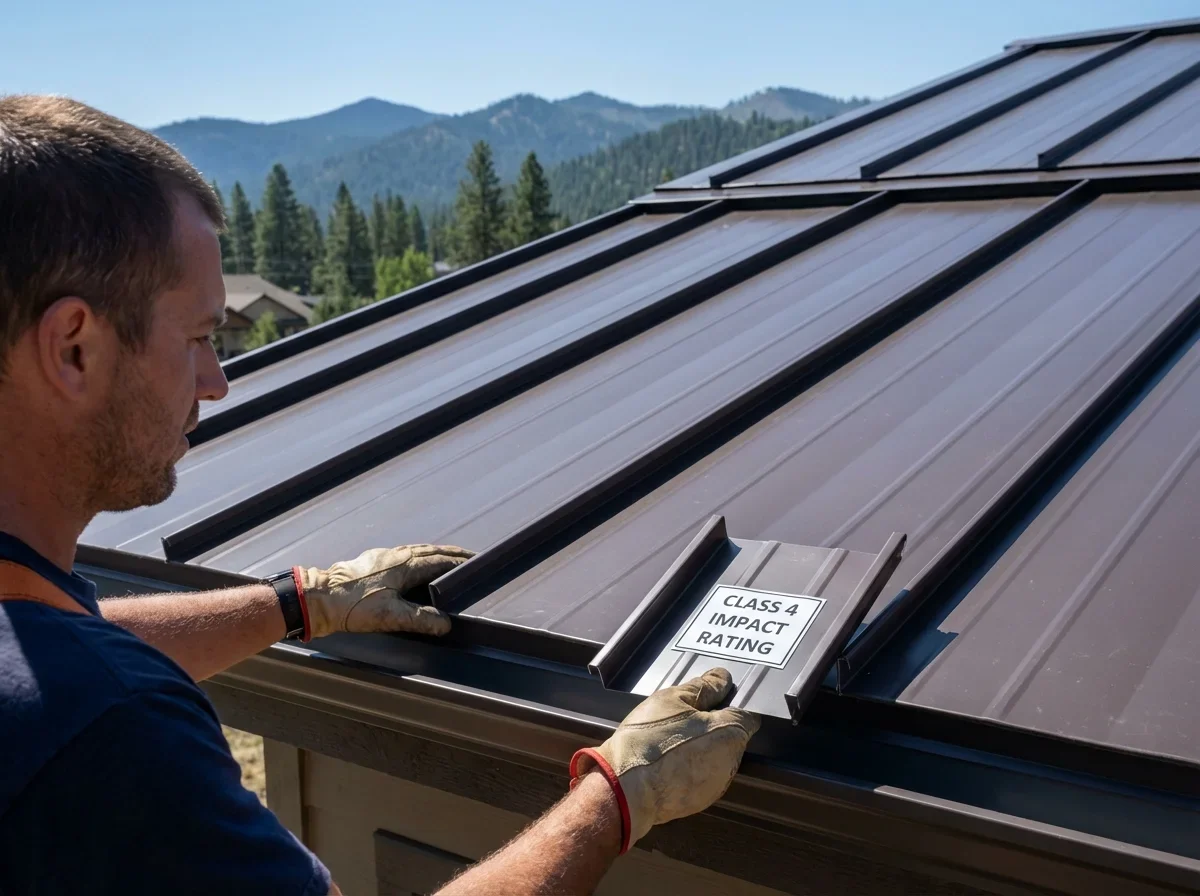
Colorado insurance companies now offer premium discounts for Class 4 impact-resistant roofing, and metal roofing qualifies if it passes UL 2218 testing. Not all metal roofing automatically receives Class 4 ratings. The profile, gauge, and substrate matter.
Standing seam steel (24-gauge or thicker) typically achieves Class 4 with proper deck support. Stone-coated steel systems like Decra and Metro qualify by design.
Corrugated metal with exposed fasteners usually doesn't qualify because fastener holes create weak points.
Insurance discounts range from 15% to 28% depending on your carrier and deductible structure. On a $2,500 annual premium, that's $375-$700 per year. Over a 30-year metal roof lifespan, you'll save $11,250-$21,000. Enough to offset a significant portion of the material premium over asphalt shingles.
To claim the discount, you need documentation from your contractor showing the specific product installed and its UL 2218 Class 4 certification. Your insurance company won't take your word for it. Many homeowners report frustration when their contractor couldn't provide the certification paperwork needed to unlock discounts, even though the material technically qualified.
Class 4 Insurance Discount Quick Facts:
- Discount range: 15-28% on annual premiums
- 30-year savings potential: $11,250-$21,000
- Required documentation: UL 2218 certification from contractor
- Qualifying materials: 24-gauge+ standing seam, stone-coated steel systems
- Non-qualifying: Exposed-fastener corrugated metal
- Average annual savings on $2,500 premium: $375-$700
Hidden Costs and Budget Add-Ons
Metal roofing projects reveal costs that don't surface until mid-installation. Homeowners consistently report these surprises:
Gutter replacement becomes necessary when switching from asphalt to metal. Metal roofs shed snow in avalanche-like sheets that rip off standard K-style gutters. You need either continuous hangers (every 16 inches instead of every 24) or upgraded gutter systems designed for metal roofs.
Add $8-$15 per linear foot for proper gutter reinforcement, totaling $1,600-$3,000 for a typical home. See details in our gutter installation cost guide.
Snow guards or snow fences are essential in Colorado unless you enjoy burying your landscaping, deck, or air conditioning unit under cascading ice sheets. S-5! ColorGard systems run $18-$30 per linear foot installed. A complete snow retention system covering critical eave areas costs $2,500-$5,000.
Mountain homes with steep pitches may need double rows of guards.
Ridge venting must be redesigned for metal roofs. Standard shingle-over ridge vents don't work with standing seam. You need metal ridge caps with integrated ventilation baffles, adding $25-$40 per linear foot compared to standard ridge venting.
Color matching sounds cosmetic but affects real costs. Stock colors (bare Galvalume, white, black, brown) cost the base price. Custom colors add $50-$100 per square. If you want your metal roof to match specific trim colors or HOA requirements, expect 10-15% higher material costs and 3-4 week lead times for paint runs.
Deck repairs surface once tear-off begins.
Expansive clay soil along the Front Range causes foundation movement that stresses roof framing. Several homeowners budgeted $25,000 for metal roofing and ended up spending $29,000-$32,000 after discovering cracked rafters, rotted sheathing around old nail penetrations, or structural issues hidden under layers of asphalt.
Altitude and UV Impact on Longevity
Colorado's elevation compounds the economic case for metal roofing in ways that don't apply in lower-altitude states. Denver at 5,280 feet receives 50% more UV radiation than sea level. Mountain communities above 8,000 feet see UV intensity 60-70% higher than coastal areas.
Asphalt shingles rated for 25-30 year lifespans in sea-level climates fail in 18-22 years along the Front Range.
Metal roofing resists UV degradation if you choose proper coatings. Kynar 500 (also called PVDF) coatings hold color and resist chalking in Colorado's UV environment. Cheaper polyester or SMP coatings fade noticeably in 8-12 years and chalk within 15 years.
The coating premium runs $50-$80 per square. On a 2,000-square-foot roof, that's $1,000-$1,600 extra. But it determines whether your roof looks good in year 15 or looks weathered and chalky. Several homeowners report choosing budget painted metal to save $1,800 upfront, then regretting it when their "burgundy" roof turned pink-brown after seven Colorado summers.
Daily temperature swings of 60°F (30°F at dawn, 90°F by afternoon in summer) cause expansion-contraction cycles that stress fasteners and seams. Standing seam systems accommodate this movement through clip systems that allow panels to float.
Cheaper exposed-fastener systems fight the movement, loosening screws and cracking gaskets.
Storm Chaser Contractors and Trust Signals
Major hail events flood Colorado with out-of-state roofing crews. Within 48 hours of a severe storm, you'll see door-knockers offering free inspections, insurance claim assistance, and aggressive pricing.
Some are legitimate restoration contractors. Many are storm chasers who disappear after collecting deposits.
Red flags include:
- Out-of-state license plates and no local business address
- Pressure to sign contracts immediately with "storm pricing that expires tomorrow"
- Requests for full payment upfront or deposits over 30%
- No local references or verifiable past projects
- Unwillingness to provide manufacturer certifications or contractor credentials
Colorado doesn't require state-level roofing licenses, but most municipalities require local registration. Denver requires contractors to register with the Department of Excise and Licenses. Colorado Springs, Aurora, Boulder, Fort Collins, and Lakewood have similar requirements.
Ask to see municipal registration and verify it through local government websites.
Manufacturer certifications signal commitment to the area. GAF Master Elite contractors must maintain minimum volume, warranty standards, and local presence. Metal roofing manufacturers like ATAS, McElroy, and Englert offer installer certification programs requiring ongoing training.
Contractors who invest in these programs typically aren't storm chasers.
Check the Better Business Bureau, but also search for the company name plus "Colorado" plus "reviews" or "complaints." Several homeowners report that storm chasers create temporary business names with clean BBB records, then abandon the name after the season ends.
For guidance on vetting contractors properly, see how to hire a roofing contractor in Colorado and how to verify a Colorado roofing contractor.
Financing Options and Payment Structures
Metal roofing's upfront cost pushes many homeowners toward financing. Colorado contractors typically offer three payment structures:
Cash/check discounts of 3-5% are common. On a $30,000 project, that's $900-$1,500 saved by avoiding credit card processing fees or financing kickbacks.
Contractors prefer cash flow over convenience, and you gain negotiating leverage.
Contractor-arranged financing through GreenSky, Service Finance, or similar programs offers 12-24 month same-as-cash periods if you pay off the balance before the promotional term ends. Miss the deadline by one day and you owe deferred interest calculated from day one (often at 17-24% APR).
Read terms carefully. Several homeowners report surprise interest charges of $3,000-$5,000 when they miscalculated payoff timing.
Home equity lines of credit (HELOC) typically offer lower rates (7-9% as of 2026) with flexible repayment. If you have equity and plan to repay over several years, a HELOC costs less than contractor financing. The downside: you're secured by your home, and interest isn't tax-deductible unless you meet IRS improvement criteria.
Standard payment schedules break into three parts: deposit (20-30% to order materials), mid-project payment (40-50% when tear-off and deck prep complete), and final payment (20-30% upon completion and inspection).
Never pay 100% upfront. Colorado law limits deposits to one-third of contract value for home improvement projects over $500, but enforcement is inconsistent.
Energy Efficiency and Cool Roof Considerations
Metal roofing reflects solar radiation better than asphalt shingles, reducing cooling loads in summer. In Colorado's climate with 300+ days of sunshine, this matters more than in cloudy regions.
Cool roof coatings with high solar reflectance (SR) and thermal emittance (TE) can lower surface temperatures by 30-50°F compared to dark asphalt. White or light-colored metal roofs perform best. A light-gray standing seam roof might reach 130°F on a 90°F day, while dark asphalt hits 180°F.
Cooling cost savings vary by home design and insulation.
Well-insulated homes with adequate attic ventilation see minimal benefit. Older homes with undersized insulation and poor attic airflow might save $100-$300 per summer in air conditioning costs.
Colorado doesn't offer statewide tax credits for cool roofing, but utility companies occasionally run rebate programs. Xcel Energy has offered $300-$500 rebates for cool roof installations in past years. Check current programs before signing contracts. Some mountain communities offer incentives for fire-rated metal roofing in wildfire zones.
Metal roofs also shed snow faster than asphalt, reducing ice dam risk. Ice dams form when heat loss melts snow on upper roof sections, then refreezes at cold eaves. Metal's low-friction surface and vertical seam orientation encourage snow to slide off before melting.
You still need proper attic insulation and ventilation, but metal roofing reduces ice dam frequency compared to asphalt.
Maintenance Costs Over Lifespan
Metal roofing requires less maintenance than asphalt but isn't maintenance-free. Budget for these ongoing costs:
Fastener inspection every 5-7 years for exposed-fastener systems. Screws loosen due to thermal cycling. Contractors charge $300-$600 to walk the roof, check every fastener, and replace failed gaskets.
Standing seam systems with concealed fasteners don't need this service.
Coating touchup on Kynar 500 finishes every 20-25 years if you want to restore appearance. Stone-coated steel may need granule reapplication in high-traffic areas (roof access paths) after 15-20 years.
Copper roofs need no coating maintenance. Patina is the finish.
Valley and flashing inspection every 3-5 years to check for seal failures where metal meets penetrations. Expansive clay soil movement along the Front Range shifts flashing connections. Catching small gaps early costs $200-$400 to reseal. Ignoring them leads to $2,000-$5,000 leak repairs when water infiltrates wall cavities.
Snow guard maintenance includes checking for loose brackets after heavy snow seasons. Guards that fail mid-winter can't be reinstalled until spring, leaving your property vulnerable to ice avalanches.
Total maintenance costs over 30 years typically run $2,000-$4,000 for standing seam systems, $4,000-$7,000 for exposed-fastener systems.
Compare this to asphalt shingles requiring full replacement every 18-22 years in Colorado's climate at $12,000-$18,000 per replacement. The maintenance difference becomes substantial over time.
Comparing Metal to Other Colorado Roofing Options
Metal roofing competes with several alternatives in Colorado's market. Understanding tradeoffs helps justify the cost.
Class 4 impact-resistant asphalt shingles cost $6,500-$11,000 installed for 2,000 square feet. They qualify for the same insurance discounts as metal and handle hail damage reasonably well. Lifespan is 20-25 years in Colorado's UV environment versus 40-50 years for metal.
You'll replace asphalt once, possibly twice, during metal's lifespan. See the full comparison at asphalt shingles vs metal roofing in Colorado.
Concrete tile runs $18,000-$28,000 installed and lasts 40+ years. It handles hail well and doesn't fade in UV. Weight is the issue. Tile requires structural analysis and possible rafter reinforcement on older homes. Metal roofing weighs 1.5-2 pounds per square foot versus 7-10 pounds for tile.
If your home wasn't built for tile, adding it costs $5,000-$12,000 in framing upgrades.
Synthetic slate or shake costs $15,000-$25,000 installed. These systems mimic traditional materials while offering Class 4 impact resistance. Lifespan runs 30-40 years. They're lighter than tile but heavier than metal.
The main advantage is aesthetics. HOAs that ban metal often approve synthetic slate because it looks traditional.
Cedar shake is banned in many Colorado wildfire zones and costs $14,000-$22,000 installed where allowed. Fire-rated synthetic shake alternatives offer similar appearance with Class A fire ratings. See cedar shake vs synthetic fire-rated options for mountain home comparisons.
For a broader overview, check Colorado roofing materials: which is best for your climate.
Insurance Claims and Metal Roofing Damage
Colorado's hail environment means you'll likely file a claim at some point. Metal roofing changes the claims process in important ways.
Functional vs. cosmetic damage is the key distinction. Insurance pays to restore function, not appearance. A dented metal roof that still sheds water may not qualify for replacement.
Adjusters argue that cosmetic dents don't impair performance. You'll fight over whether 1-inch dimples that hold water and accelerate corrosion constitute functional damage.
Stone-coated steel systems fare better in claims because granule loss clearly indicates impact damage, similar to asphalt shingles. Smooth standing seam panels show dents but may not meet functional damage thresholds unless seams fail or panels crease severely.
Matching issues complicate partial replacements. If hail damages your south-facing roof plane but leaves the north side intact, your insurance company wants to replace only the damaged section. Metal roofing colors fade at different rates depending on sun exposure. A new panel installed in 2026 won't match a panel installed in 2019 that's weathered seven summers.
You'll have a two-tone roof unless you negotiate full replacement.
Recoverable depreciation works differently for metal roofing. Because metal roofs last 40+ years, insurance companies apply depreciation schedules that reduce actual cash value for older installations. A 10-year-old metal roof might receive only 75% of replacement cost as initial payout, with the remaining 25% (recoverable depreciation) paid after you complete repairs.
Several homeowners report surprise when their "fully covered" metal roof damage resulted in $8,000-$12,000 out-of-pocket costs due to depreciation and deductibles.
For detailed guidance on navigating claims, see Colorado roof insurance claims: a complete guide and insurance claim assistance & documentation services.
When Metal Roofing Makes Financial Sense
Metal roofing's higher upfront cost pays off under specific circumstances common in Colorado.
You plan to stay 15+ years. Break-even versus asphalt shingles happens around year 12-15 when you'd face the first asphalt replacement. Stay another decade and metal's lifetime value becomes undeniable.
You're in a high-hail corridor. If you've replaced your roof twice in 10 years due to hail, metal roofing with Class 4 rating plus insurance discounts shifts the math dramatically.
The peace of mind alone justifies the cost for homeowners tired of filing claims.
Your home has structural capacity. Older Front Range bungalows with 2x4 rafters can't support tile but handle metal easily. If tile is your aesthetic preference but your structure can't carry it, metal offers similar lifespan at lower weight and cost.
You value low maintenance. Time-poor homeowners who'd rather not think about roofing for 30 years find metal roofing appealing despite higher initial outlay.
No more 3-5 year shingle inspections or granule loss anxiety.
You're in a wildfire zone. Mountain and foothills homeowners facing Class A fire-rating requirements need metal, tile, or synthetic products anyway. Metal often costs less than tile and installs faster than synthetics while meeting code.
Metal roofing makes less sense if you're selling within 5 years (you won't recoup the premium), if your home has extreme complexity that drives installation costs past $50,000, or if HOA restrictions ban metal entirely.
Getting Accurate Quotes for Your Project
Metal roofing estimates vary wildly based on what contractors include. Request itemized quotes breaking out:
- Material costs per square by product type and gauge
- Labor costs per square for installation
- Tear-off and disposal fees
- Deck repairs (estimate range if condition is unknown)
- Underlayment and ice barrier
- Flashing and trim work
- Permits and inspection fees
- Snow guards or retention systems
- Gutter modifications
- Warranty coverage (material and workmanship)
Get three quotes minimum.
The cheapest bid usually cuts corners on underlayment, fastener quality, or deck prep. The most expensive bid isn't always the best. Sometimes you're paying for overhead, not quality. Mid-range bids from established local contractors with verifiable references typically offer the best value.
Ask for references from projects completed 3-5 years ago, not just recent work. Call those homeowners and ask about leak issues, color fade, contractor responsiveness, and whether the project stayed on budget.
Drive by completed projects to see aging and weathering patterns.
Verify credentials before signing: municipal registration, liability insurance (minimum $1 million), workers' compensation coverage, and manufacturer certifications. Don't accept verbal promises. Request copies of certificates.
Timing matters for competitive pricing. Get quotes in winter (December-February) when contractors are slow. You'll see 8-12% lower prices than peak season (May-August).
Sign contracts in winter for spring installation and lock in off-season rates while securing a spot before the rush.
Final Cost Considerations
Metal roofing in Colorado ranges from $22,000 to $45,000 for most residential projects, with mountain properties and complex designs pushing toward the upper end. Material choice drives 40-50% of cost variation, installation complexity adds another 30%, and regional factors account for the rest.
Your specific project cost depends on metal type, roof size and pitch, geographic location, contractor selection, and hidden factors like deck condition and permit requirements.
The homeowners who report the most satisfaction planned for 10-15% cost overruns, scheduled projects during shoulder seasons, and chose mid-tier materials with proven Colorado performance over cheapest-available options.
For additional context on roof replacement budgeting, see how much does roof replacement cost in Colorado. For emergency situations requiring immediate attention, review emergency roof damage: what to do right now.
Frequently Asked Questions
- Colorado Department of Local Affairs, Division of Housing. "Building Codes and Standards for Construction in Colorado." https://cca.colorado.gov/building-codes. Accessed April 08, 2026.
- Colorado State University Extension. "Roofing Materials for Colorado's Extreme Weather." https://extension.colostate.edu/topic-areas/structure-housing/roofing-materials-for-colorados-extreme-weather-6-718/. Accessed April 08, 2026.
- Colorado Division of Insurance. "Hail-Resistant Roofing Systems in Colorado." https://www.colorado.gov/pacific/dora/insurance-hail-resistant-roofing. Accessed April 08, 2026.
- Colorado Roofing Association. "Colorado Roofing Association Guidelines for Metal Roofing." https://www.coloradoroofing.org/standards/metal-roofing-guidelines. Accessed April 08, 2026.
- Colorado Energy Office. "Energy Efficiency Standards for Roofing in Colorado." https://energyoffice.colorado.gov/standards/roofing-efficiency. Accessed April 08, 2026.