
What Class 4 Impact-Resistant Shingles Actually Are
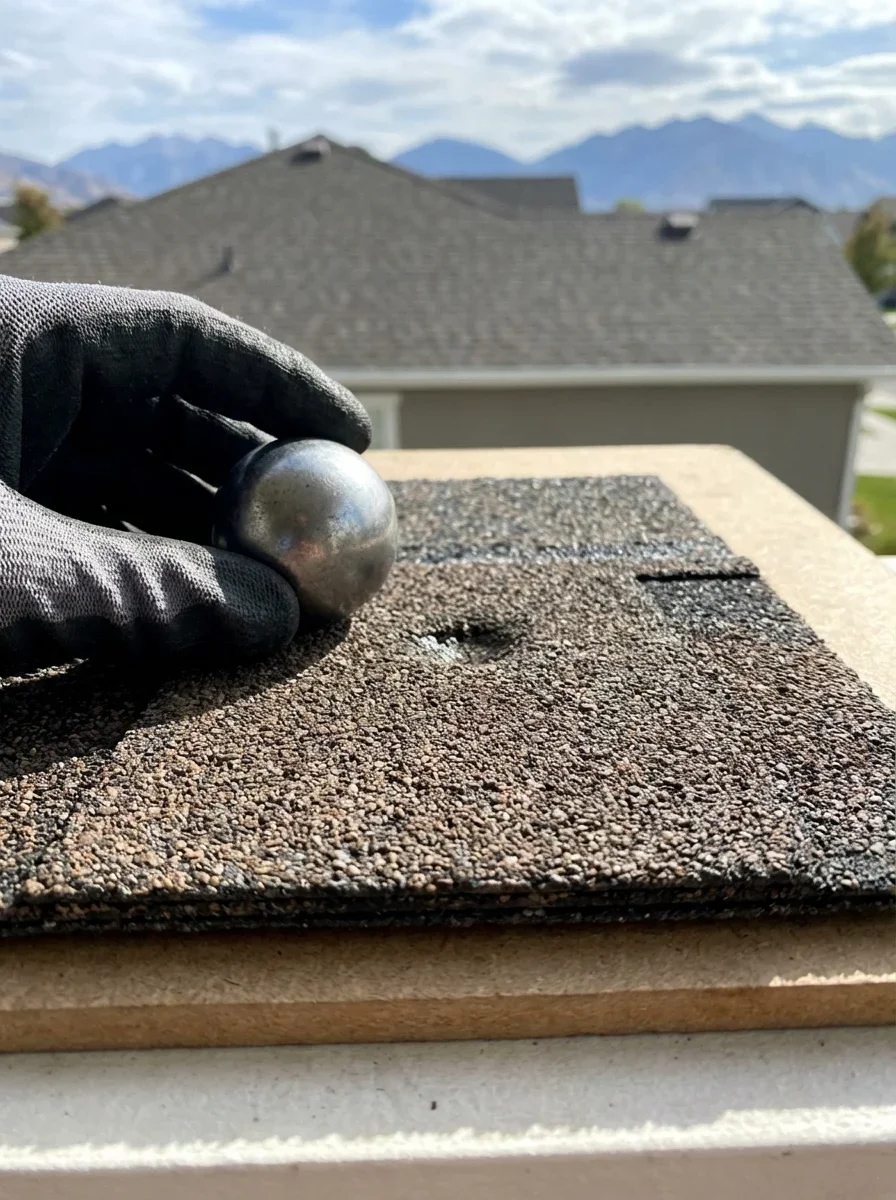
Class 4 is the highest impact-resistance rating a roofing material can earn under UL 2218 testing standards. To qualify, a shingle must withstand two direct strikes from a two-inch diameter steel ball dropped from 20 feet—simulating roughly the force of baseball-sized hail traveling at terminal velocity.[5] The shingle can't crack, split, or tear through to the underlying deck.
Class 3 shingles face the same test with a smaller 1.75-inch ball. Most standard architectural shingles fall into Class 3 or below.
The difference between those two classes matters significantly in Colorado. A two-inch hailstone is common during severe Front Range storms, and your roof sees far more UV exposure at 5,280 feet than comparable shingles would at sea level. That accelerated degradation combined with 60-degree temperature swings that stress sealant bonds means Class 4 shingles earn their premium through longevity as much as immediate impact resistance.
How UL 2218 Testing Works
Samples get conditioned to specific temperatures, then struck twice in the same spot. The tester inspects for cracks visible from below the shingle, granule loss exposing the asphalt mat, and any punctures or tears. Shingles that show any of those failures don't earn the Class 4 rating.
Manufacturers typically achieve impact resistance through SBS (styrene-butadiene-styrene) polymer modification of the asphalt, or by adding rubberized compounds that allow the shingle to flex rather than fracture on impact.
Not all Class 4 products use the same chemistry. Some rely on thicker asphalt layers, others on proprietary polymer blends. Two shingles with identical UL ratings can perform differently five years into Colorado's climate—one stays flexible at altitude while another becomes brittle and loses granules.
| Impact Rating | Test Ball Size | Hail Size Equivalent | Typical Shingle Type |
|---|---|---|---|
| Class 4 | 2 inches | Baseball-sized | SBS-modified premium asphalt |
| Class 3 | 1.75 inches | Large marble | Standard architectural |
| Class 2 | 1.5 inches | Golf ball | Basic architectural |
| Class 1 | 1.25 inches | Walnut | Three-tab shingles |
Where Class 4 Shingles Are Required in Colorado
Larimer County—covering Fort Collins, Loveland, Estes Park, and surrounding communities—mandates Class 4 impact-resistant asphalt shingles for all new construction, roof replacements, and any repair exceeding 25% of the roof area.[1] The requirement stems from the county's designation as a High-Wind Area with ultimate design wind speeds of 140 mph or greater.
If you're pulling a permit in Larimer County, your contractor must document Class 4 shingles on the application and provide photos of shingle wrappers showing the impact rating at final inspection.
Lafayette adopted similar requirements effective March 15, 2021, requiring Class 4 Impact Resistant Shingles for all residential roofing projects.[2] Roof inspections in Lafayette now require documentation proving Class 4 compliance before final approval. Longmont doesn't explicitly mandate Class 4, but does require all asphalt shingles to meet 110 mph sustained wind ratings—a standard that eliminates traditional three-tab shingles from nearly all installations.[3]
Wind and Nail Pattern Requirements
Westminster, designated as a special wind region, requires high-wind nailing patterns per manufacturer specifications for all asphalt shingle installations.[4] That typically means six nails per shingle instead of four, placed in a specific pattern tested under ASTM D 7158 standards.
Parker's Building Division similarly requires final inspection documentation including photos of shingle wrappers showing approved products.[6]
Most Front Range municipalities have adopted wind-resistance standards that effectively push you toward Class 4 shingles even where not explicitly required. The combination of hail mandates, wind ratings, and insurance incentives means Class 4 has become the de facto standard for residential roofing across the metro area.
How Much Insurance Discounts Actually Matter
Colorado insurers typically offer 15-28% discounts on wind and hail premiums when you install Class 4 shingles. On a $550,000 home with $2,200 annual homeowners insurance, that translates to $330-$616 in annual savings—enough to recover the premium cost of Class 4 shingles within 8-12 years.
Your actual discount depends on your insurer, location, and claims history, but the savings are real and continue for the life of the roof.
The discount structure matters more than the percentage, though. Most insurers apply the reduction only to the wind/hail portion of your premium, not the total policy cost. Since wind and hail coverage represents roughly 30-40% of a typical Front Range policy, that 20% discount might only reduce your total premium by 6-8%. Still meaningful over 30 years, but worth understanding the actual math before you commit.
Some insurers now require Class 4 shingles to even issue new policies in high-hail areas like Broomfield, Westminster, and Parker.
If you're buying a home or switching carriers, you may not get coverage at any price without upgrading to impact-resistant materials first.
Class 4 Shingle ROI Quick Facts:
- Material premium: $1,000-$1,500 on typical 2,200 sq ft home
- Annual insurance savings: $330-$616
- Payback period: 8-12 years
- Extended warranty: 30-50 years vs 20-30 years standard
- Potential avoided claim deductible: $5,500-$11,000 per storm
- Resale value recovery: 60-70% of installation cost
Class 4 Shingle Cost vs Standard Architectural Shingles
Expect to pay $150-$225 per square (100 square feet) for mid-tier Class 4 shingles, compared to $110-$165 for standard architectural shingles. Premium SBS-modified Class 4 products can run $250-$325 per square. On a typical 2,200-square-foot Denver ranch with 25 squares of roofing, the Class 4 premium adds $1,000-$1,500 to material costs.
Labor doesn't change significantly. Class 4 shingles install using the same methods as standard products, though some contractors charge slightly more for the high-wind nail patterns required in special wind regions.
Total installed cost for a Class 4 roof replacement in the Denver metro typically runs $8,500-$14,000, depending on roof complexity, accessibility, and material selection. Roughly 10-15% more than a standard architectural shingle roof.
Long-Term Value Beyond Insurance Discounts
Class 4 shingles generally carry 30-50 year warranties compared to 20-30 years for standard products. The extended lifespan matters more at altitude, where UV degradation shortens effective roof life by 25-30% compared to sea-level conditions.
A shingle rated for 30 years in Houston might only last 20-22 years in Denver. But a properly manufactured Class 4 shingle maintains better granule adhesion and asphalt integrity under that same UV stress.
You'll also file fewer insurance claims over the roof's life. Each hail claim typically comes with a 1-2% deductible on your home's value—$5,500-$11,000 on a median Colorado home. Avoiding even one claim by having impact-resistant shingles pays for the upgrade cost immediately.
Which Class 4 Shingle Brands Actually Perform in Colorado
Not all Class 4 shingles prove equally durable in real-world Front Range conditions. Some products that passed UL 2218 testing showed disappointing performance during Colorado Springs hailstorms in 2018, particularly among certain non-SBS-modified formulations.
Quality varies enough between manufacturers that specifying "Class 4" alone doesn't guarantee you're getting a roof that will handle Colorado's climate for three decades.
GAF Timberline HDZ and Owens Corning Duration Storm represent the most commonly installed Class 4 products in Colorado, both using SBS-modified asphalt for improved flexibility. CertainTeed NorthGate and Malarkey Legacy offer competitive alternatives with similar polymer enhancement. Atlas StormMaster and IKO Nordic maintain Class 4 ratings but use different formulations—some contractors report better cold-weather installation characteristics with SBS products.
SBS-Modified vs Standard Class 4 Formulations
SBS (styrene-butadiene-styrene) modification makes asphalt more flexible at low temperatures, which matters during Colorado's spring and fall installation seasons when roof deck temps can drop to 40-50°F overnight. Standard asphalt shingles become brittle below 45°F, making them prone to cracking during installation.
SBS-modified products remain pliable down to 25°F, extending the installation window and reducing application damage that can void warranties.
That flexibility continues to benefit you after installation. Freeze-thaw cycling—common during Denver's winter months with daytime highs near 50°F and overnight lows in the teens—stresses shingle adhesive bonds. SBS-modified shingles expand and contract with less stress accumulation, maintaining better seal integrity over decades.
Installation Requirements Unique to Colorado
High-wind nailing is mandatory in most Front Range jurisdictions, requiring six nails per shingle instead of the standard four.[4] Nail placement follows a specific pattern tested under ASTM D 7158 standards—typically two nails 1 inch from each end, and four more evenly spaced across the shingle's nailing line.
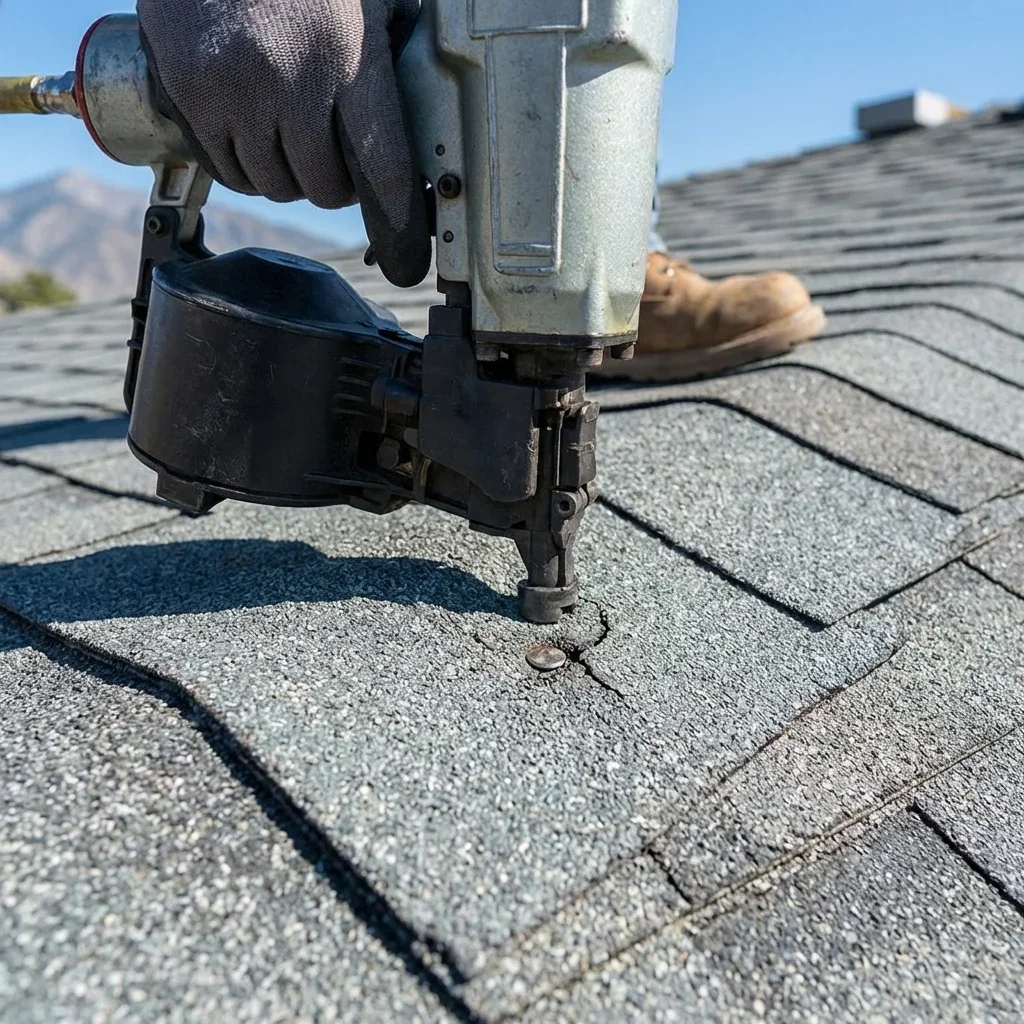
Manual nailing is recommended for Class 4 products even though most Colorado crews use pneumatic nailers, since over-driven or under-driven nails compromise impact resistance.
Valley installation becomes critical in Colorado's expansive clay soil conditions. Foundation movement along the Front Range shifts rooflines slightly over time, concentrating stress at valleys and causing flashing seals to break. Proper valley flashing—either woven with step flashing or installed with ice-and-water shield extending 12 inches beyond the valley centerline—prevents the leaks that commonly develop 5-7 years into a roof's life when soil movement has stressed seals.
Permit and Inspection Documentation
You'll need to provide Class 4 documentation at permit application in most municipalities. That means having shingle wrapper photos showing the UL 2218 Class 4 rating before your contractor starts work.
Final inspections require the same documentation. Inspectors will check that the installed product matches the permitted materials.[6]
Some jurisdictions require additional documentation for high-wind nailing patterns. Your contractor should photograph nail placement on a sample section before covering it with the next course. That photographic evidence becomes important if warranty issues arise later or if an insurance claim requires proof of proper installation.
Pro Tip: Keep your original shingle wrapper photos and installation documentation in a dedicated home maintenance file. You'll need them for insurance claims, permit inspections, warranty registration, and to prove Class 4 compliance to future home buyers. Many homeowners discover they can't access insurance discounts years later because they lack this simple documentation.
How Altitude and UV Affect Class 4 Shingle Lifespan
Denver receives roughly 50% more UV radiation than coastal cities at sea level, accelerating granule loss and asphalt oxidation. Granules protect the asphalt mat from UV breakdown—once they're gone, the mat degrades rapidly.
Class 4 shingles use enhanced granule adhesion systems and UV-resistant asphalt modifiers to slow this process, but even premium products will lose granules faster at altitude than manufacturer lifespan estimates suggest.
Expect to lose about 10-15% of your shingle's rated lifespan purely due to altitude effects. A 30-year Class 4 shingle might realistically deliver 25-27 years in Denver, compared to 18-22 years for a standard 20-year architectural shingle. That differential still makes Class 4 the better long-term value, but understand that "30-year warranty" doesn't mean 30 years of like-new performance at 5,280 feet.
Temperature cycling compounds UV stress. A shingle that reaches 160°F during July afternoons and drops to 20°F on January nights experiences material fatigue that coastal roofs never see. The 140-degree daily swing—common during spring and fall—causes expansion and contraction that loosens granules and stresses adhesive seals.
SBS modification helps, but even the best Class 4 shingles face harsher conditions in Colorado than anywhere else in the lower 48 states.
Class 4 Shingles and Hail Damage Claims
Class 4 shingles dramatically reduce the likelihood of hail damage claims, but they don't make your roof invincible. Storms dropping golf-ball-to-softball-sized hail (2-4 inches) can still damage even the best impact-resistant products, particularly if hail falls at steep angles driven by high winds.
The Class 4 rating protects against the most common hail sizes—up to two inches—which account for roughly 80% of Front Range hail events.
When you do file a claim after a severe storm, having Class 4 shingles strengthens your position with adjusters. Insurance companies are more likely to approve repair-only claims for localized damage on impact-resistant roofs, rather than total replacements. That can mean lower deductibles and faster settlements, since your insurer knows the bulk of the roof retained its integrity.
Post-Storm Documentation
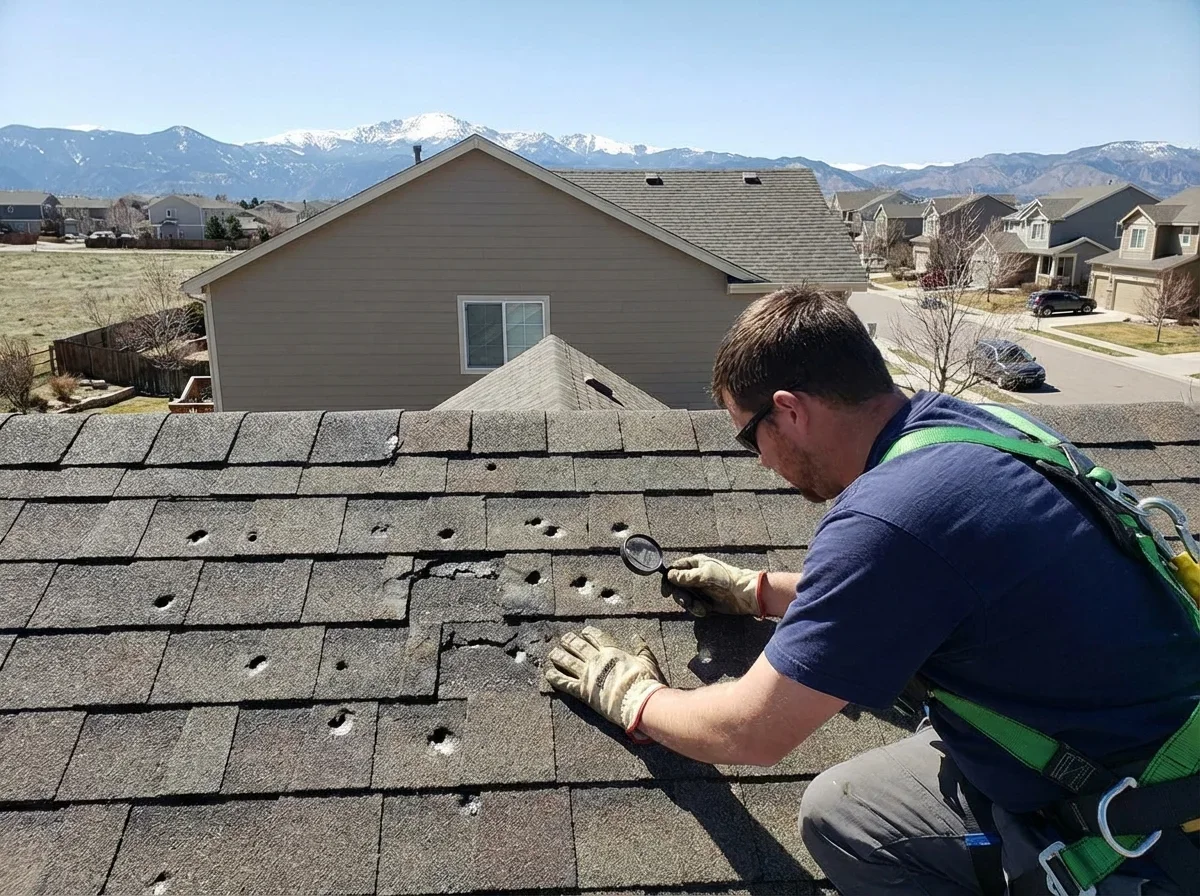
Get a professional inspection within 30 days of any significant hail event, even if you don't see obvious damage from ground level. Hail impact marks—circular divots where granules are displaced—aren't always visible to untrained eyes, but they represent legitimate damage that will shorten your roof's effective life.
Adjusters look for 8-10 impacts per 10x10-foot test square when determining whether replacement is warranted.
On Class 4 shingles, you'll typically need more severe or widespread impact patterns to justify full replacement compared to standard products.
Document everything with photos and keep records of your shingle brand, installation date, and UL 2218 certification. If an adjuster questions whether your roof truly has Class 4 shingles, those wrapper photos from permit inspection prove your case.
Choosing a Contractor for Class 4 Installation
Colorado requires no state-level roofing license, which means contractor quality varies widely. Municipal licensing requirements exist in Denver, Colorado Springs, Aurora, Boulder, Fort Collins, and Lakewood, but standards differ by jurisdiction.
Your best verification comes from checking local registration status, verifying insurance coverage, and confirming the contractor's experience with Class 4 installations specifically.
Ask potential contractors how many Class 4 roofs they've installed in your municipality within the past year. Familiarity with local permitting processes—particularly the documentation requirements for Class 4 compliance—separates experienced local crews from storm chasers who flood the market after major hail events. A contractor who can't immediately cite your jurisdiction's specific nail pattern requirements or inspection photo protocols probably hasn't done enough local work to know the details that matter.
Verify workers' compensation and general liability coverage directly with the insurance carrier, not just by viewing a certificate. Colorado requires workers' comp if the contractor has employees, and virtually all municipalities require general liability.
Call the number on the certificate and confirm coverage is active and sufficient—$1 million general liability minimum, $500,000 workers' comp.
You can verify contractor registration status through the Colorado Division of Regulatory Agencies at colorado.gov/dora.
GAF Master Elite and Manufacturer Certifications
GAF Master Elite certification indicates a contractor has met specific training requirements and maintains good standing with the manufacturer. While not a guarantee of quality, it demonstrates ongoing education and access to enhanced warranty coverage.
For Class 4 installations, manufacturer certifications matter because they often unlock longer material warranties—50-year coverage instead of 30-year, or lifetime warranties on premium products.
Owens Corning Platinum Preferred contractors and CertainTeed SELECT ShingleMaster companies offer similar benefits. These certifications require annual training on proper installation techniques, which is particularly relevant for Class 4 products where nail placement and adhesive activation affect impact resistance.
Common Mistakes That Void Class 4 Warranties
Over-driven nails—where the pneumatic nailer embeds the nail head below the shingle surface—create weak points that concentrate impact stress. Under-driven nails that don't fully seat allow shingles to lift in high winds, exposing nail shanks to weather and creating entry points for moisture.
Both conditions void manufacturer warranties and reduce actual impact resistance below the UL 2218 rating.
Installing Class 4 shingles in cold weather without proper precautions causes seal failures. Shingle adhesive strips require temperatures above 40°F to activate properly. Installers working in March or October need to hand-seal each tab with roofing cement if temperatures don't reach activation thresholds for several days post-installation.
Skipping this step means shingles never properly adhere. They'll blow off in the first significant wind event.
Mixing Class 4 shingles with standard products during repairs violates code in jurisdictions with Class 4 mandates and can void your entire roof warranty. If you need to replace damaged sections on a partially Class 4 roof, you must match the impact rating. One reason to keep leftover shingles from your original installation—you'll have exact matches if repairs become necessary.
How Class 4 Shingles Affect Home Resale Value
Impact-resistant roofing adds modest resale value in Colorado's current market—typically recovering 60-70% of installation cost when you sell. Buyers in hail-prone areas increasingly expect Class 4 shingles as standard, particularly in Larimer County and other jurisdictions where they're mandatory for new construction.
A home with a recent Class 4 roof becomes more attractive to buyers who understand they'll avoid a $12,000-$15,000 replacement expense for decades.
The insurance discount transfers to new owners, which makes the benefit easily quantifiable during negotiations. Listing agents should explicitly mention the Class 4 rating, installation date, manufacturer, and available warranty transfers in property disclosures. Those details help justify asking price and differentiate your home from comparable listings.
Transferable Warranties
Most Class 4 shingle warranties are transferable to new owners within specific timeframes—typically full coverage for the first 10-15 years, then prorated coverage for the remaining warranty period. GAF, Owens Corning, and CertainTeed all allow one-time transfers, though some require registration within 30-90 days of sale.
Make sure you complete manufacturer registration after installation and provide those documents to buyers at closing.
Maintenance Requirements for Class 4 Shingles
Class 4 shingles require the same basic maintenance as standard products: annual inspections, gutter cleaning, debris removal, and prompt repair of damaged flashing or seals. Colorado's climate adds a few specific concerns.
Freeze-thaw cycling can loosen valley flashing even on impact-resistant roofs. Check valleys each spring for gaps or lifted metal.
Ice dams, while less common on well-insulated homes, can still form during heavy snow years and should be removed promptly to prevent water infiltration.
Granule loss tracking matters more at altitude. During your annual inspection, check downspouts and gutters for excessive granule accumulation. Some granule loss is normal in the first year as loose manufacturing residue washes off, but continuing heavy loss after year two suggests UV degradation is accelerating. Your signal to start planning for eventual replacement, even if the shingles still look acceptable from ground level.
Professional Inspections After Hail Events
Schedule professional inspections within 30 days of any hail event larger than one inch. Even Class 4 shingles can sustain hidden damage that won't become obvious until months later when damaged areas start leaking.
Many Colorado roofing contractors offer free inspections after significant storms, though you should verify the company's local credentials before granting roof access.
Document inspection findings with photos and written reports, even if no damage appears. That record establishes your roof's condition before the storm, which becomes important if future weather events cause damage and you need to prove which storm caused what problems. Insurance companies increasingly scrutinize multi-storm claims, and contemporary documentation protects your interests.
Class 4 Shingles vs Metal Roofing for Impact Resistance
Metal roofing offers comparable or superior hail resistance depending on panel gauge and coating system. Standing-seam metal with 24-gauge steel or heavier typically outperforms Class 4 shingles in severe hail, though cosmetic denting can occur with softball-sized stones.
Metal costs $12,000-$22,000 installed on a typical Front Range home—roughly 40-60% more than Class 4 shingles.
The decision often comes down to longevity expectations and aesthetic preferences. Metal roofs can last 50-70 years in Colorado's climate with minimal maintenance, compared to 25-30 years for Class 4 shingles. But metal's higher initial cost means you won't break even on that longevity advantage for 20-25 years.
If you're planning to sell within 10-15 years, Class 4 shingles deliver better cost-recovery on investment.
Insurance discounts are similar for both materials—you'll get the same 15-28% premium reduction with properly installed metal as with Class 4 shingles. Some insurers offer slight additional discounts for metal in wildfire-risk zones since it carries a Class A fire rating, but that advantage only applies in WUI (wildland-urban interface) designated areas along the foothills.
Fire Ratings and Wildfire Considerations
Class 4 impact resistance doesn't automatically mean Class A fire rating—those are separate UL certifications. Most Class 4 asphalt shingles do carry Class A fire ratings, but verify this explicitly if you're building or replacing a roof in wildfire-risk zones along Colorado's Front Range foothills.
Communities affected by the Marshall Fire and other recent wildland-urban interface fires now mandate Class A fire-rated roofing, effectively prohibiting cedar shake and other combustible materials.
Class A rating requires the roof assembly—shingles, underlayment, and decking—to resist fire penetration for two hours and prevent flame spread across the surface. Your contractor must install the complete assembly as tested, including specified underlayment types and deck materials.
Using different underlayment than specified in the UL listing can void the fire rating even if the shingles themselves are Class A certified.
Frequently Asked Questions
- Larimer County Government. "Roofing - Larimer County." https://www.larimer.gov/sites/default/files/uploads/2022/roofing.pdf. Accessed April 08, 2026.
- City of Lafayette Building Department. "Class 4 IR Shingles Requirements Lafayette Colorado." https://www.lafayetteco.gov/361/Building-Code-Design-Information. Accessed April 08, 2026.
- City of Longmont Building Inspection. "Roofing Guidelines for Commercial and Residential Projects." https://longmontcolorado.gov/building-inspection/roofing-guidelines-for-commercial-and-residential-projects-1/. Accessed April 08, 2026.
- City of Westminster Building Division. "Residential Re-roofing Guide." https://www.westminsterco.gov/DocumentCenter/View/5084/Roofing-Guide-82625. Accessed April 08, 2026.
- Colorado Roofing Association. "Class 3 vs Class 4 Shingles: Which is Best For Colorado Homes?." https://www.coloradoroofing.org/news/class-3-vs-class-4-shingles-colorado-homes. Accessed April 08, 2026.
- Town of Parker Building Division. "BUILDING DIVISION Re-Roofing Requirements." https://www.parkerco.gov/DocumentCenter/View/738/Roofing-Requirements-Handouts?bidId=. Accessed April 08, 2026.