
What Storm Chasers Are (and Why Colorado Attracts Them)
Storm chaser roofers are contractors who travel from state to state following severe weather events. They arrive in damaged neighborhoods within 48 hours, canvass door-to-door, and leave once insurance checks clear — often before completing all the work.
Colorado is prime storm chaser territory.
The Front Range corridor experiences an average of seven significant hail events annually, with Denver metro seeing Category H3-H5 hail storms (1.75 to 4-plus-inch diameter) every 18 to 24 months. The May 2017 storm alone caused $2.3 billion in insured losses across the metro area. When a single event creates that much work, out-of-state contractors flood in.
Unlike states with strict licensing requirements, Colorado has no statewide roofing license — making it easier for unlicensed contractors to operate. Most municipalities like Denver, Colorado Springs, and Boulder require local contractor registration, but enforcement happens after complaints roll in, not before.
Storm chasers exploit this gap by working fast and moving on before homeowners realize what happened.
| Storm Chaser Contractor | Legitimate Local Contractor |
|---|---|
| Out-of-state plates, temporary addresses | Brick-and-mortar office, local presence |
| Available immediately after storm | Booked 6+ months after major events |
| No permit history or recent permits only | Multi-year permit history across addresses |
| Disappears before warranty issues surface | Available for warranty work years later |
| Often no workers' comp insurance | Fully insured with verifiable coverage |
| Pressures you to sign immediately | Gives time to review and compare bids |
Red Flags That Signal a Storm Chaser
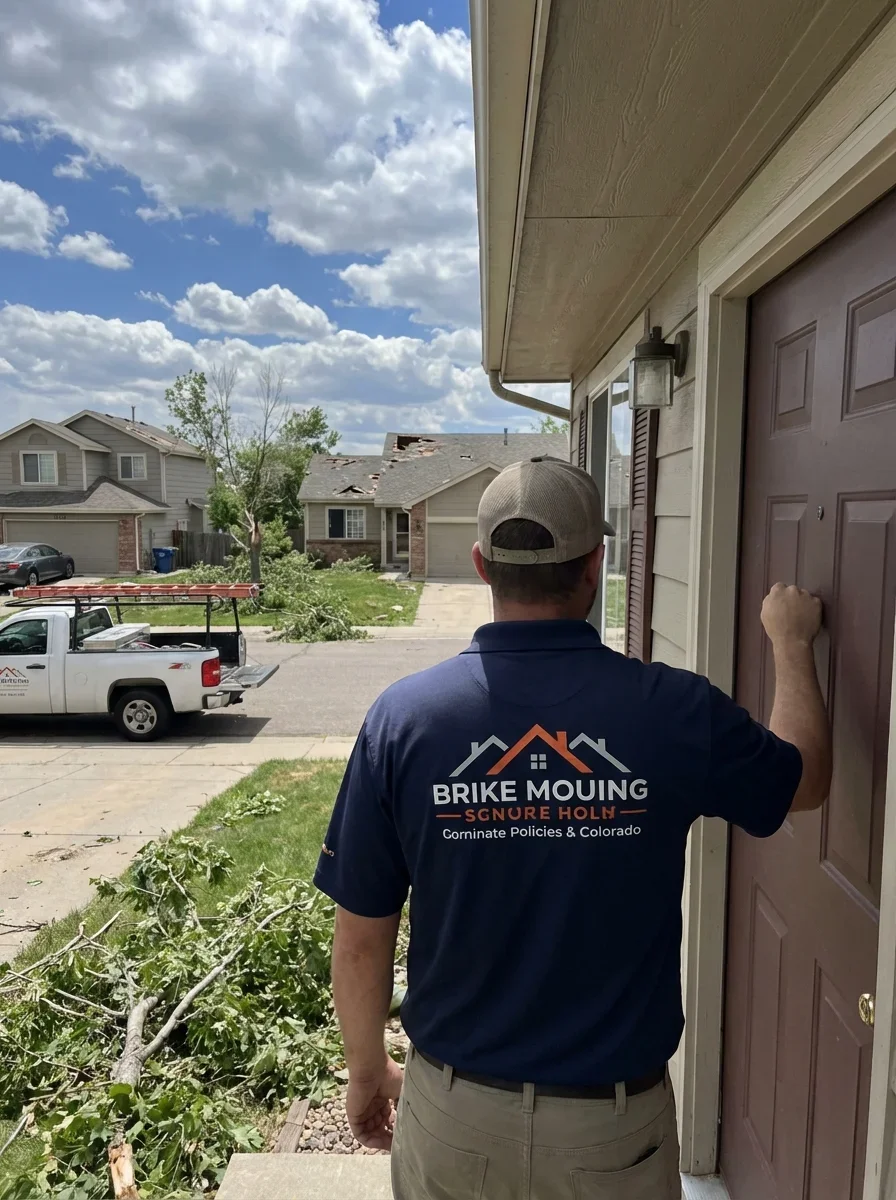
You can spot storm chasers through specific patterns that legitimate local contractors don't follow. These aren't subtle hints — they're bright red warning signs.
Out-of-State Plates and Temporary Addresses
Storm chasers drive vehicles with out-of-state license plates and list hotel addresses or P.O. boxes as their business location. Lafayette residents reported callers who claimed to be "working in the neighborhood" but never showed up, leaving homeowners who took the bait feeling it was "a waste of time" and stressful[1].
Check the business address on their paperwork. If it's a UPS Store mailbox or a temporary office rental, that's your answer.
Legitimate Colorado contractors have brick-and-mortar offices they've operated for years.
Unsolicited Door Knocking and Immediate Availability
Storm chasers don't wait for you to call them — they show up unannounced right after a storm. They emphasize they're "already in your neighborhood" and can start work immediately, sometimes the next day.
Here's the reality: after major Front Range hail events like the May 2017 or July 2018 storms, licensed insured Denver contractors are booked six-plus months out.
A contractor promising to start tomorrow either has no other clients (bad sign) or is operating without proper permits and inspections (worse sign). Legitimate local contractors prioritize existing clients and work through queues systematically.
Pressure Tactics Around Insurance Deadlines
Storm chasers create artificial urgency by claiming your insurance claim has a tight deadline or that you need to act immediately to secure coverage. One homeowner noted that "a hail storm creates the exact conditions where rushed decisions become expensive," and emphasized the importance of comparing multiple contractors rather than accepting the first offer.
Colorado law does give you specific timeframes to file claims after discovering damage, but the claim filing window and the contractor selection decision are separate issues. You can file your claim promptly, have an adjuster assess damage, and then choose a contractor on your timeline.
Scheduling six months out with a licensed contractor is normal and won't jeopardize your claim as long as the adjuster visit happens within your insurer's timeframe.
Offers to Waive Your Insurance Deductible
If a contractor offers to waive, rebate, or pay your insurance deductible, walk away. Legislation signed by Governor Hickenlooper in 2012 explicitly prohibits roofing contractors from waiving insurance deductibles — it's a tactic storm chasers use to undercut competition[5].
This isn't just unethical. It's insurance fraud.
The contractor inflates the claim to cover your deductible, the insurance company pays more than actual damage warrants, and you're legally complicit. When the fraud surfaces (and it often does), your insurance can be cancelled and you may face criminal charges.
Contracts That Give Them Full Insurance Control
Storm chasers often push contracts that authorize them to negotiate directly with your insurance company and require you to sign over the entire insurance check to them, regardless of work quality or completion. Homeowners wish they'd understood that signing these contracts means losing decision-making power entirely — the contractor gets paid whether you're satisfied or not.
Colorado Senate Bill 38 requires that any residential roofing contract over $1,000 must explicitly identify the contractor's liability insurance provider and their contact information[2]. If the contract doesn't list this, it's a red flag that the contractor may not carry proper insurance. The law also includes a 72-hour rescission clause giving you three days to cancel after signing.
Requests for Large Upfront Payments
Legitimate contractors working insurance restoration jobs don't need large deposits — they get paid when the insurance company releases funds after work completion.
Storm chasers ask for 50% or more upfront because they plan to collect and leave before finishing the job.
Colorado law requires roofing contractors to maintain a surety bond of at least $50,000 to cover consumer disputes[4]. Storm chasers operating without full local licensing evade this requirement. If they disappear with your deposit, you have no bond to claim against.
How to Verify a Contractor's Legitimacy
You can check credentials yourself in about 15 minutes. Don't rely on what the contractor tells you — verify everything independently.
Check Municipal Licensing (Denver Example)
Denver requires a municipal contractor's license issued by the Community Planning and Development Department. The contractor must employ someone with a Denver Supervisor Certificate for Roof Covering/Waterproofing, which requires two years of documented field experience.
Verify any contractor's license at denvergov.org/epermits. Search by business name or license number.
A legitimate local contractor will have permit history spanning multiple years across multiple addresses. Storm chasers show up with no permit history or only permits from the last three to six months.
Colorado Springs, Boulder, Fort Collins, Aurora, and Lakewood all have similar municipal licensing requirements. Check with your local building department for the specific verification portal.
Verify Insurance Directly with the Carrier
Don't accept a photocopy of an insurance certificate from the contractor. Call the insurance company directly using the phone number on the Certificate of Insurance (COI) and verify that the policy is active and covers the dates of your project.
Colorado law requires workers' compensation insurance for any roofing contractor with employees. Many storm chasers misclassify all workers as "independent subcontractors" to avoid this $8,000 to $15,000 annual cost per crew.
If an uninsured worker is injured on your property, you can be held liable.
Request a current Certificate of Insurance showing workers' comp coverage and verify it's active.
Check Colorado Roofing Association Membership
The Colorado Roofing Association (CRA) requires members to prove licensing, carry minimum $500,000 liability insurance, maintain two years in business, and pass an industry exam. Storm chasers by definition cannot meet the "two years in business locally" requirement.
Verify CRA membership at coloradoroofing.org. This is a quick third-party trust verification that immediately filters out transient contractors.
Learn more about what CRA membership means and why it matters.
Verify Manufacturer Certifications
Top-tier manufacturers like GAF (Master Elite), Owens Corning (Platinum Preferred), and CertainTeed (ShingleMaster) certify contractors who meet specific training, insurance, and customer satisfaction requirements. These certifications unlock enhanced warranties (up to 50 years) that storm chasers cannot offer.
Verify a contractor's certification status directly on the manufacturer's website contractor locator tool, not from a badge on their website.
If you're comparing GAF Master Elite contractors versus standard contractors, the certification should be verifiable through GAF's own system.
Check Better Business Bureau Records
Better Business Bureau accreditation requires a business to be operational for at least 12 months and commit to dispute resolution standards. Storm chasers who move from state to state after major events cannot maintain long-term BBB accreditation.
Check the BBB profile for the business's founding date, complaint history, and whether they've been accredited long enough to establish a track record. An A+ rating with three-plus years of history is a strong signal.
Home improvement scams rank among the five riskiest scams, with a median loss of $1,800 per victim.
Pro Tip: Create a contractor verification spreadsheet with columns for license number, insurance carrier, CRA membership, manufacturer certifications, and BBB rating. Fill it out for each contractor you're considering — the ones who can't provide information for every column are automatically disqualified. This simple tracking method prevents you from getting emotionally invested in a contractor before verifying their credentials.
Why Storm Chasers Undercut Legitimate Contractors
Storm chaser pricing isn't a deal. It's a risk transfer.
They can undercut legitimate contractors by 20 to 30% because they operate outside the regulatory and insurance frameworks that protect you.
The Cost Savings Come from Skipped Requirements
Storm chasers save money by not carrying Colorado workers' comp insurance ($8,000 to $15,000 per year per crew), not pulling Denver permits ($200 to $500 per job), and using unlicensed labor classified as "subcontractors" to avoid liability. They work on volume arbitrage — get in, collect, and move to the next storm before warranty issues surface.
Unpermitted work can void manufacturer warranties, complicate future insurance claims, and create title issues during home sales. Denver building inspectors can issue stop-work orders and require complete tear-offs of unpermitted work.
All roofing work in Colorado requires a permit, and permit records are public and searchable on the Denver e-permits portal.
They Disappear Before Problems Manifest
Most roofing failures manifest in years three through seven, not immediately. Storm chasers are long gone by then.
Homeowners report that warranty repairs are "very difficult to obtain" because the contractor no longer exists at the listed address or phone number.
Colorado's climate accelerates failure timelines. At Denver's 5,280-foot elevation, roofs receive approximately 50% more UV radiation than sea-level locations, which accelerates shingle granule loss and reduces typical manufacturer lifespan estimates by 25 to 30%. The Front Range's expansive bentonite clay soil swells up to 10% when wet and shrinks when dry, causing foundation movement that shifts rooflines and breaks flashing seals in valleys and at penetrations.
Storm chasers doing quick patch work often don't re-seal flashing properly for Colorado soil conditions, leading to leaks within two to three years.
If you need help addressing freeze-thaw roof damage or signs of hail damage, you need a contractor who'll be here when those issues surface.
What Legitimate Colorado Contractors Do Differently
Local licensed contractors follow a different process because they're building long-term reputations, not chasing one-time paydays.
They Pull Permits and Schedule Inspections
Legitimate contractors pull permits for every job and schedule Denver building inspections. This takes time and costs money, but it ensures your roof meets the International Residential Code (IRC) requirements, including R802.3 requiring roofs in high-altitude regions to support a minimum 20 pounds per square foot snow load[3].
Storm chasers often skip permits and install roofs that don't meet Colorado's structural requirements.
Permits also create a paper trail that protects you. If there's a dispute, you have documentation showing the work was inspected and approved. Without permits, you have no proof the work was done correctly.
They Employ Haag Certified Inspectors
Legitimate Colorado roofing contractors specializing in insurance restoration employ Haag Certified Inspectors (HCI-R for residential). This certification requires completing Haag Engineering's comprehensive training on damage identification and assessment methodology.
Storm chasers rarely hold this credential.
Ask for the inspector's Haag certification number and verify it at haag.com. This separates professionals who can document storm damage accurately from opportunists who inflate claims or miss legitimate damage.
They Offer Long-Term Warranty Backing
Local contractors offer manufacturer warranties and workmanship guarantees they'll actually honor. If a leak develops in year five, they're still here to address it.
Storm chasers offer the same warranty language, but it's worthless when the business no longer exists.
When you're choosing between asphalt shingles and metal roofing or evaluating Class 4 impact-resistant shingles, the warranty matters only if the contractor is still around to honor it.
They Help with Insurance Claims Without Controlling Them
Legitimate contractors provide insurance claim assistance and documentation — they'll meet with your adjuster, provide detailed damage assessments, and help you understand your coverage. But they don't demand full control of the claim or require you to sign over checks before work is done.
If you're navigating a Colorado roof insurance claim, you want help, not someone taking over.
There's a big difference.
Quick Reference: Why Storm Chasers Cost Less
- Skip $8,000–$15,000 workers' comp insurance per crew
- Avoid $200–$500 permit fees per job
- Use unlicensed labor classified as "subcontractors"
- Don't maintain $50,000 surety bonds
- Leave before 3–7 year warranty period when failures occur
- Install roofs that don't meet IRC R802.3 snow load requirements
- Risk voiding your manufacturer warranty and future insurance coverage
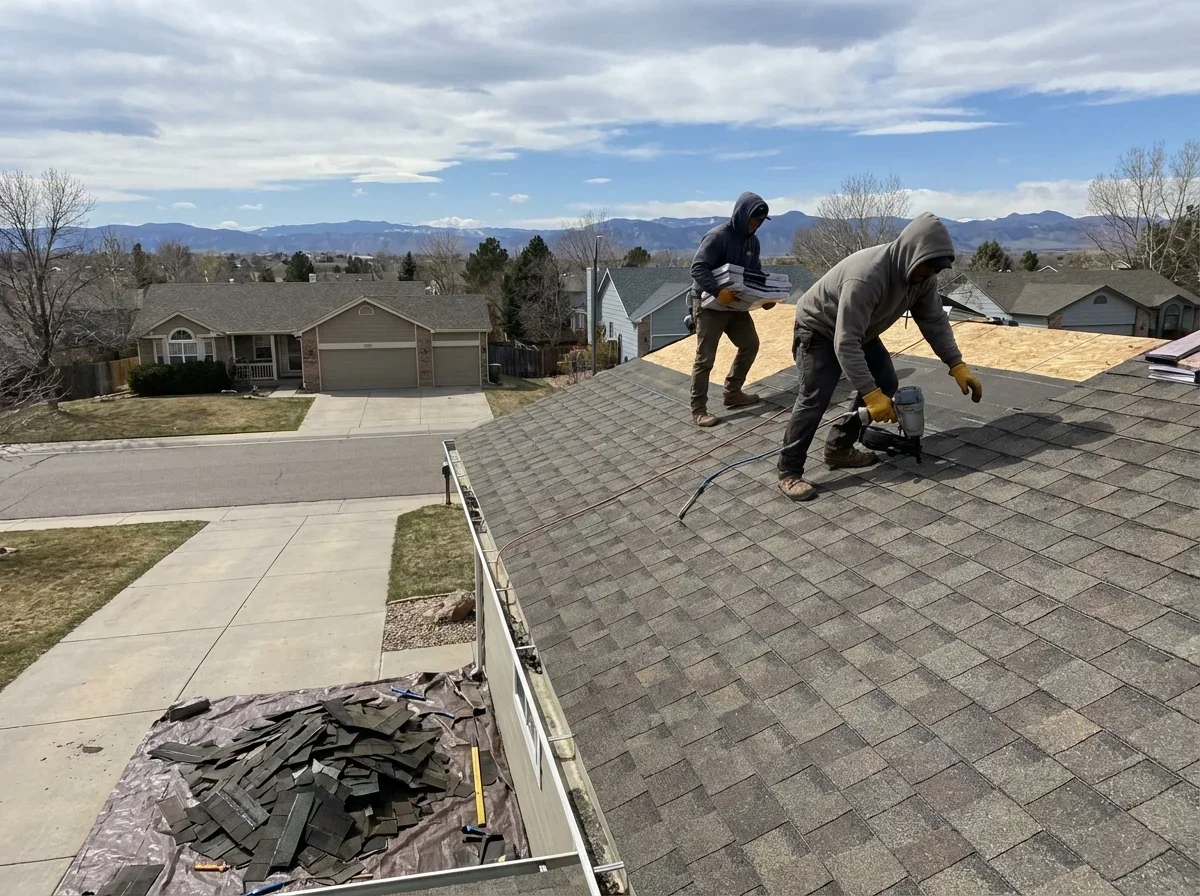
The Before-You-Sign Verification Checklist
Before signing any roofing contract after a Colorado hail storm, complete these verification steps. Print this list and check each box.
Licensing and Credentials:
- Verified contractor's municipal license at local building department website
- Confirmed Supervisor Certificate holder name matches license application
- Checked permit history — shows multiple years of continuous local work
- Verified CRA membership at coloradoroofing.org (if applicable)
- Confirmed manufacturer certification on manufacturer's website (not contractor's site)
Insurance and Bonding:
- Obtained Certificate of Insurance listing liability and workers' comp
- Called insurance carrier directly to verify active coverage
- Confirmed coverage dates include your project timeline
- Verified surety bond meets Colorado's $50,000 minimum
Contract Review:
- Contract lists contractor's liability insurance provider and contact info (Senate Bill 38 requirement)
- No clauses waiving, rebating, or paying your insurance deductible
- No requirements to sign over insurance checks before work completion
- 72-hour rescission clause included (Colorado law)
- Specific scope of work, timeline, and payment schedule detailed
- Permit acquisition responsibility explicitly stated
Business Verification:
- Physical brick-and-mortar office address (not P.O. box or UPS Store)
- BBB profile shows 3+ years accreditation history
- Google reviews span multiple years (not all recent)
- Business phone number has local area code
- Vehicles have Colorado plates
Red Flag Screen:
- No unsolicited door knocking immediately after storm
- No pressure tactics about insurance deadlines
- No promises to start immediately or next day
- No requests for 50%+ upfront payment
- No claims about "working the whole neighborhood today"
If you can't check every box, don't sign. One red flag might be explainable.
Multiple red flags mean walk away.
What to Do Right After a Hail Storm
Your first 48 hours after a hail event set the tone for everything that follows. Here's the right sequence.
Document damage immediately. Take photos and videos of your roof, siding, gutters, downspouts, and any visible dents or cracks. Photograph hail stones next to a ruler for size reference. Time-stamp everything.
This creates your damage baseline before anyone touches your property.
File your insurance claim promptly, but don't rush contractor selection. Call your insurance company within the timeframe specified in your policy (typically 30 to 90 days from damage discovery). Tell them you're aware of the damage and would like to file a claim. This starts the clock and protects your coverage.
But the adjuster visit and contractor selection are separate decisions — you control the timeline on both.
Get a professional inspection from a licensed contractor you choose. Don't accept free inspections from door knockers. Instead, call two or three licensed local contractors and request formal inspections. Many offer free hail damage assessments as part of their insurance restoration services.
Compare their documentation — legitimate contractors provide detailed reports with photos, measurements, and specific damage locations.
Meet the insurance adjuster with your contractor present. Schedule the adjuster visit and have your contractor meet them on-site. The contractor can point out damage the adjuster might miss and explain why certain repairs are necessary for Colorado's climate.
This isn't combative. It's collaborative.
Adjusters expect contractors to be present during insurance restoration inspections.
Compare bids based on documentation and follow-through, not speed. Get written estimates from at least three contractors. Compare their scope of work line by line. Ask them to explain their reasoning in plain language — why repair versus replace, what materials they recommend for Colorado's climate, and how they handle permitting and inspections.
The fastest contractor is rarely the best choice.
If you're facing emergency roof damage, call a contractor who offers emergency repair services — but still verify their credentials before letting them on your roof.
The Long-Term Cost of Hiring a Storm Chaser
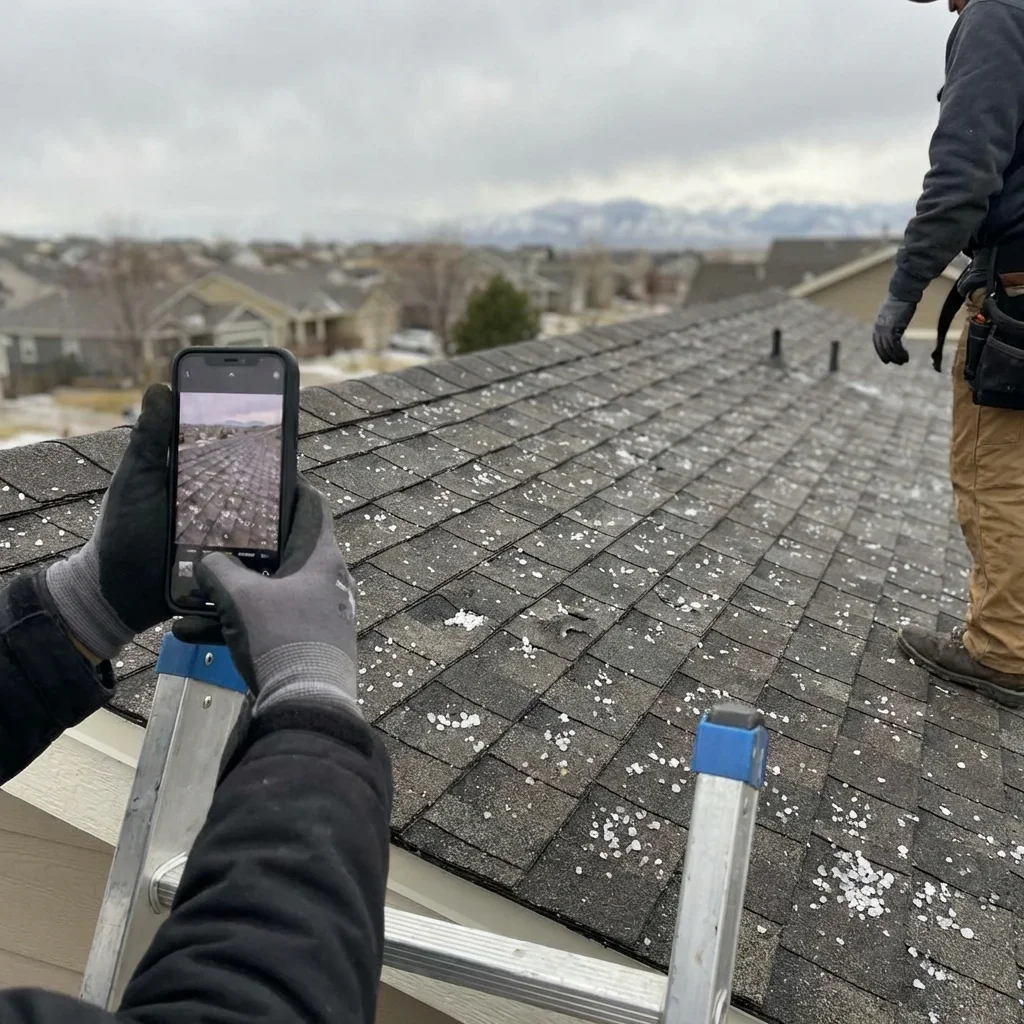
Storm chaser jobs cost homeowners far more than the initial savings. Here's what happens when the work fails and the contractor is gone.
Insurance won't cover unpermitted work. If your storm chaser didn't pull permits and the work fails, your insurance company can deny future claims related to that roof. They'll argue the roof was improperly installed and any subsequent damage stems from workmanship, not covered perils.
You're stuck paying for repairs out of pocket.
Manufacturer warranties are void. GAF, Owens Corning, CertainTeed, and other major manufacturers void warranties if roofs are installed without permits or by uncertified contractors.
That 50-year warranty the storm chaser promised? It's worthless if they didn't follow manufacturer installation requirements.
You inherit liability for injuries. If a worker was injured during your roof installation and the contractor didn't carry workers' comp insurance, you can be sued directly. Colorado law makes homeowners liable for uninsured worker injuries on their property.
One serious fall can cost you hundreds of thousands of dollars.
You can't sell your house cleanly. Title companies and buyers' agents check permit records during real estate transactions. Unpermitted roof work shows up and raises red flags. Buyers will demand proof of code compliance or negotiate steep price reductions.
Some won't close at all until the roof is brought up to code — which may mean tearing off and replacing the entire roof.
The median loss is $1,800, but totals can be far higher. While the median financial loss for home improvement scams is $1,800, that's just the immediate loss. Add in the cost of re-roofing with a legitimate contractor, lost insurance coverage, title issues, and legal fees, and you're looking at $15,000 to $50,000 in total costs.
That's the real price of saving 20% upfront.
How to Report Storm Chaser Activity
If you've been contacted by a suspected storm chaser or hired one and experienced problems, report it. Your report helps protect other homeowners and supports enforcement efforts.
Better Business Bureau: File a complaint at bbb.org. Include the business name, contact information, and details of what happened.
BBB complaints create public records that warn other consumers.
Colorado Attorney General's Office: The Consumer Protection Section investigates contractor fraud. File complaints at coag.gov or call 720-508-6000. They track patterns and can take legal action against repeat offenders.
Local Building Department: If work was done without permits, report it to your municipal building department. They can issue stop-work orders, investigate code violations, and require remediation.
Colorado Department of Regulatory Agencies (DORA): While Colorado doesn't license roofers at the state level, DORA provides consumer resources and tracks complaints. Visit colorado.gov/dora to file reports and access contractor verification guidance.
National Insurance Crime Bureau (NICB): Report suspected insurance fraud to NICB at 800-835-6422 or nicb.org. Storm chasers who inflate claims or commit deductible fraud undermine the entire insurance system.
The more homeowners report suspicious activity, the harder it becomes for storm chasers to operate in Colorado.
When You Can't Wait: Choosing the Best Available Option
Sometimes you genuinely can't wait six months for the most established contractor. Your roof is actively leaking, winter is coming, or insurance is threatening to deny your claim if you don't start work soon.
In these cases, you still need to verify credentials, but you're choosing the best available option in a constrained market.
Here's how to make that decision safely.
Prioritize licensing and insurance above reputation. A newer contractor with full licensing, active insurance, and permit history is safer than a highly-recommended contractor you can't verify.
Check the boxes on credentials first, then evaluate reputation.
Accept longer timelines on material delivery. After major hail events, shingle shortages are common. Legitimate contractors may have 8- to 12-week lead times on Class 4 impact-resistant shingles.
Storm chasers promise immediate material availability because they're using whatever's cheap and in stock — often not what your insurance approved or your house needs.
Pay attention to how they handle permitting. A contractor saying "we'll get the permit" is different from one saying "permits will delay the job, let's skip them." The first is managing timelines; the second is breaking the law.
Always insist on permits.
Consider temporary repairs while you wait. If you're facing immediate roof leak issues, ask contractors if they offer temporary emergency repairs (tarping, sealing, minor patching) while you wait for full replacement. This protects your home without locking you into a questionable contractor.
Document everything in writing. Get every promise, timeline, material specification, and warranty detail in writing before signing.
If a contractor won't put it in writing, they won't honor it later.
The key is separating urgency from panic. You can handle immediate risks without making a decision you'll regret for the next 10 years.
Frequently Asked Questions
- Colorado Department of Regulatory Agencies (DORA), Division of Professions and Public Safety. "Contractors (General and Specialty)." https://dpo.colorado.gov/Contractors. Accessed April 08, 2026.
- Colorado General Assembly. "House Bill 12-1039." https://leg.colorado.gov/bills/hb12-1039. Accessed April 08, 2026.
- Colorado Department of Local Affairs (DCA). "International Building Code Enforcement in Colorado." https://dca.colorado.gov/building-energy/local-building-codes-and-enforcement. Accessed April 08, 2026.
- Colorado Department of Regulatory Agencies (DORA). "Roofing Contractor Bond Requirements." https://www.colorado.gov/pacific/dora/Contractor-Bonding-Requirements. Accessed April 08, 2026.
- Colorado Attorney General's Office. "Storm Chaser Roofing Scams - Consumer Alerts." https://coag.gov/office-sections/consumer-protection/consumer-alerts/. Accessed April 08, 2026.