
What TPO and EPDM Actually Are
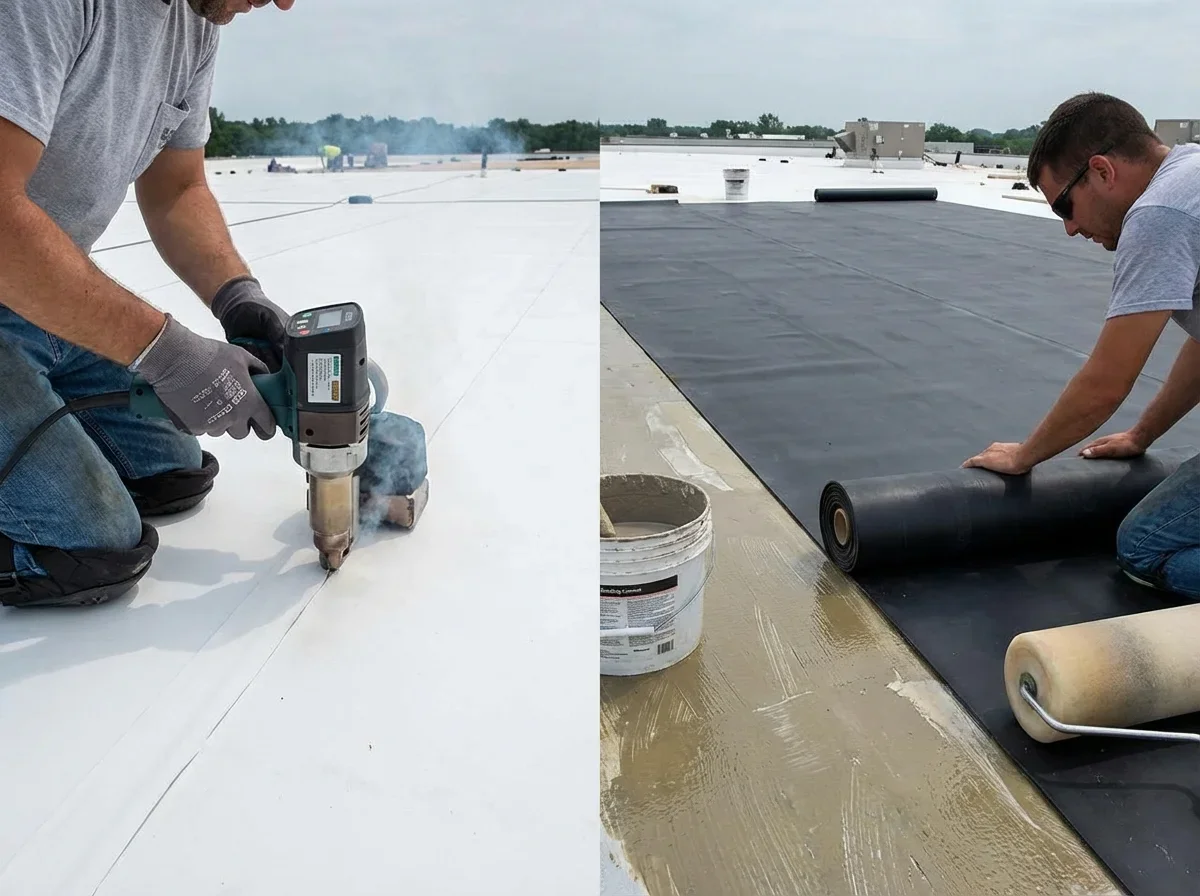
TPO (thermoplastic polyolefin) is a single-ply white or tan membrane made from polypropylene and ethylene-propylene rubber. The seams are heat-welded together using hot air guns that melt the material into a permanent bond. It's categorized as a thermoplastic, meaning it softens when heated and hardens when cooled. Contractors exploit this property during installation.[2]
EPDM (ethylene propylene diene monomer) is a synthetic rubber membrane, typically black but available in white. Seams are either taped with adhesive strips or bonded with liquid adhesives.
It's a thermoset material. Once manufactured, it won't melt or re-bond under heat. That rubber composition gives it flexibility that TPO can't match, especially in subzero temperatures.
Both materials come in rolls 10 to 20 feet wide and are installed as fully adhered, mechanically fastened, or ballasted systems depending on wind zone, building height, and local code requirements. Colorado's building code recognizes both as approved low-slope roofing materials,[1] but installation methods vary significantly. TPO demands precise welding equipment and technique. EPDM relies on adhesive chemistry and surface preparation.
A contractor skilled in one isn't automatically competent in the other. That becomes obvious when you're collecting insurance estimates after a hailstorm.
| Feature | TPO | EPDM |
|---|---|---|
| Material Type | Thermoplastic (softens when heated) | Thermoset rubber (won't re-melt) |
| Seam Method | Heat-welded (500-600°F) | Adhesive tape or liquid bonding |
| Color Options | White or tan standard | Black standard, white available at premium |
| Cold Weather Flexibility | Becomes brittle below freezing | Remains flexible to -40°F |
How Colorado's Climate Changes the Equation
UV Degradation at Altitude
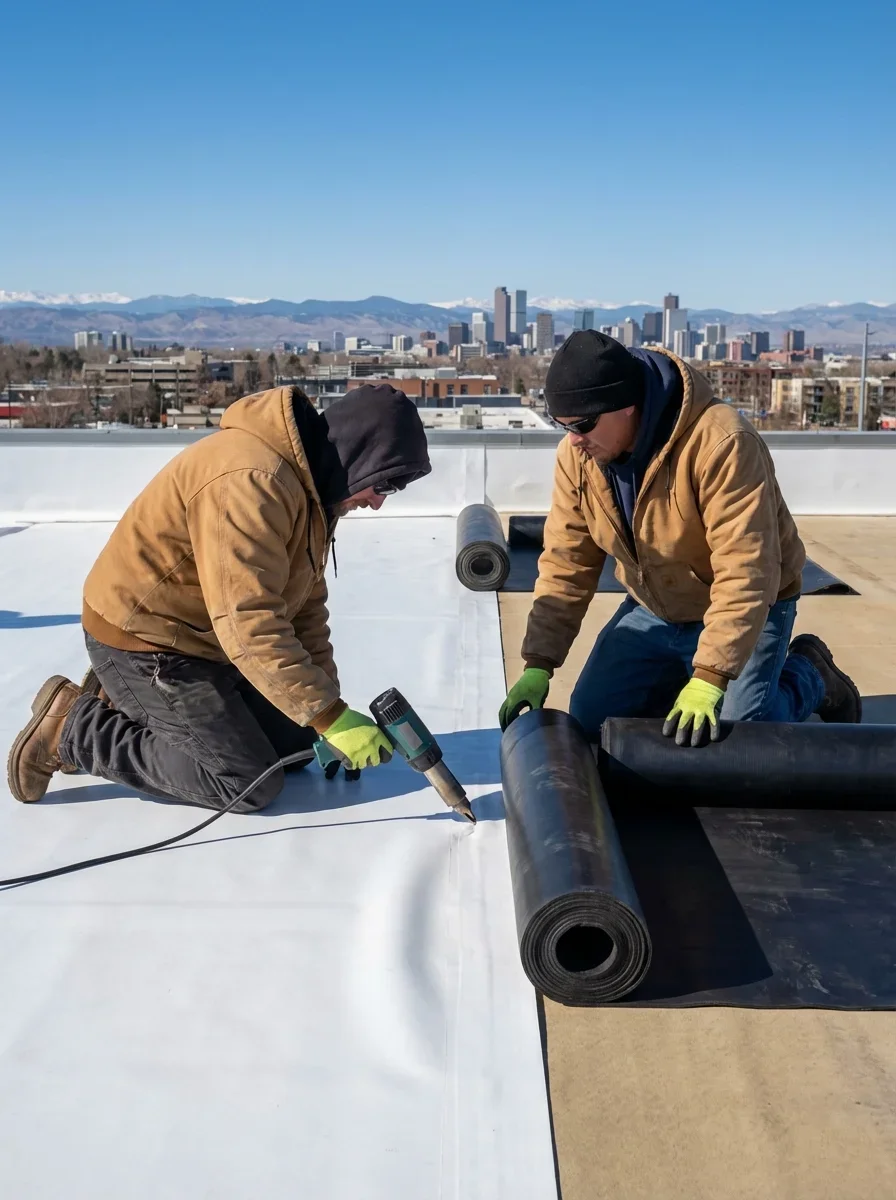
Denver sits at 5,280 feet. Every 1,000 feet of elevation increases UV exposure by roughly 8-10%. That means your flat roof absorbs 40-50% more UV radiation than the same membrane installed in Chicago or Dallas.
TPO's white reflective surface deflects much of that energy, keeping the membrane cooler and extending its service life. EPDM's black surface absorbs heat, routinely reaching 160-180°F on July afternoons. That constant thermal stress accelerates plasticizer loss in the rubber, making the material brittle over time.
White EPDM exists, but it costs 20-30% more than black and still doesn't match TPO's solar reflectance. If energy efficiency matters (and in Colorado's 300-day-a-year sunshine, it should), TPO delivers measurably lower cooling loads. Commercial building owners report 10-15% reductions in summer HVAC costs after switching from black EPDM to white TPO on low-slope sections.
Freeze-Thaw Cycling and Seam Integrity
Colorado's freeze-thaw cycles are merciless. A January morning starts at 8°F, hits 68°F by 2 PM, then drops to 15°F overnight. That 60-degree swing happens 40-60 times per winter along the Front Range.
Materials expand when warm, contract when cold. Seams experience constant stress.
TPO's heat-welded seams create a molecular bond stronger than the membrane itself. Testing shows properly welded TPO seams withstand peel strength of 20+ pounds per linear inch, well above NRCA minimums.[4] EPDM's taped or adhered seams rely on adhesive chemistry. Cold temperatures reduce adhesive tack. Installers who apply EPDM tape in November when it's 40°F may discover those seams fail in February when thermal contraction pulls them apart. The membrane itself remains flexible, but the bond doesn't.
Multiple Colorado contractors report callback rates for EPDM seam failures triple those of TPO in buildings installed during shoulder seasons. If your roof goes on in late October or early April, TPO's heat-welding process removes temperature variables from the bonding equation.
Hail Impact Resistance
Colorado's Front Range averages seven significant hail events per year. Class 4 impact-resistant shingles are now standard on sloped roofs, but flat roofing membranes don't carry the same UL 2218 impact ratings. Both TPO and EPDM rely on membrane thickness and reinforcement scrim to resist punctures.
EPDM's rubber composition absorbs impact energy better than TPO's rigid thermoplastic structure.
A 1.5-inch hailstone hitting EPDM at 60 mph will dent the membrane but often bounces off without puncturing. TPO is more prone to cracking on impact, especially if the membrane has already degraded from UV exposure or was installed too tight without allowing for thermal expansion. Thicker membranes (60-mil vs 45-mil) improve performance for both materials, but EPDM maintains a measurable advantage in puncture resistance across all thicknesses.[4]
Most hail damage on flat roofs isn't punctures. It's compromised seams and flashing.
TPO's welded seams hold better after impact. EPDM's flexibility prevents tearing, but taped seams can separate if the membrane shifts during a hailstorm. After the 2023 hailstorms in Thornton and Brighton, insurance adjusters noted higher seam failure rates on EPDM roofs with mechanically fastened systems where the membrane "tented" between fasteners and snapped adhesive bonds.
Cost Comparison for Colorado Installations
Material and Labor Pricing
EPDM typically costs $4.50-$6.50 per square foot installed for a fully adhered 60-mil system on a commercial building in the Denver metro. TPO runs $5.50-$8.00 per square foot for comparable thickness and installation method.
The 15-25% price difference comes down to labor intensity. Heat-welding TPO requires specialized equipment (hot air welders running $2,000-$4,000), trained technicians, and slower installation speeds. EPDM adhesive or tape application is faster and demands less specialized skill.
Mechanically fastened systems reduce costs for both materials. TPO drops to $4.00-$6.00 per square foot, EPDM to $3.50-$5.50. But mechanical fastening creates leak points and performs poorly in Colorado's high wind zones. Fully adhered systems are the standard recommendation for Front Range installations where 80+ mph wind gusts occur annually.
Ballasted systems (loose-laid membrane held down with river rock or pavers) cut installation costs further but add structural load. Most residential additions and many older commercial buildings can't support the extra weight. You'll need an engineer's assessment before ballasting is an option, adding $500-$1,500 to upfront costs.
Pro Tip: Calculate total cost over expected lifespan, not just installation price. EPDM's lower upfront cost may cost more over 40 years if you need two replacements versus one longer-lasting TPO installation. Factor in Colorado's harsh UV environment when estimating replacement cycles.
Lifespan and Replacement Cycles
EPDM's proven track record includes installations still performing after 30+ years with proper maintenance.[5] TPO is a newer material. Widespread commercial use began in the 1990s, so long-term performance data is thinner. Early TPO formulations had quality control issues, leading to premature failures in the 2000s. Modern formulations have stabilized, but you're still betting on 20-25 years of service life vs EPDM's documented 30+ years.
In Colorado's high-UV environment, those estimates compress.
Expect EPDM to deliver 22-28 years before brittleness and seam degradation demand replacement. TPO should hit 18-24 years if installed correctly. The cost equation shifts when you calculate replacement frequency. Spending 20% more on EPDM upfront may cost less over 40 years if it outlasts two TPO installations.
Maintenance costs also differ. EPDM requires periodic seam inspections and re-taping every 10-15 years as adhesives degrade. TPO seams rarely need attention unless physically damaged, but the membrane itself is more vulnerable to punctures from rooftop equipment traffic or wind-blown debris.
Budget $200-$400 annually for professional inspections regardless of material choice. Skipping inspections voids most manufacturer warranties and lets small problems become catastrophic leaks.
Installation Requirements and Contractor Availability
Heat Welding vs Adhesive Application
TPO installation demands precision. Seams must overlap 3-6 inches depending on manufacturer specs. The welder heats both layers to 500-600°F, creating a plasticized zone that fuses together. Weld speed, temperature, and roller pressure all affect bond strength.
Too fast and the seam is weak. Too hot and you burn through the membrane.
Colorado's wind and temperature swings during installation add complexity. Welding in 20 mph gusts or when ambient temps drop below 40°F requires experience most roofers don't have.
EPDM's adhesive or tape systems are more forgiving. Surface preparation is critical (clean, dry, primed), but the actual bonding process tolerates wider installation windows. Contractors can install EPDM in cooler temperatures and windier conditions than TPO. That flexibility matters in Colorado, where weather can turn in 30 minutes and your installation window may close unexpectedly.
Finding Qualified Contractors
Colorado doesn't require a state-level roofing license, but municipalities like Denver, Boulder, Colorado Springs, and Fort Collins have their own registration systems. Verify contractor credentials at individual city websites or through the Colorado Division of Regulatory Agencies (DORA) at https://www.colorado.gov/dora for complaints and disciplinary actions.
The Colorado Roofing Association (CRA) offers advanced training specifically for TPO and EPDM installations,[3] and contractors who've completed that coursework demonstrate higher competency than those who learned on YouTube.
Ask potential contractors how many TPO or EPDM roofs they've installed in the past 12 months. A generalist who does three flat roofs a year isn't the same as a commercial specialist who does 30. Request references from Colorado projects completed at least five years ago. You want to see how seams and flashings have held up through multiple hail seasons.
Check for manufacturer certifications from GAF, Firestone, Carlisle, or GenFlex. Certified installers get better warranty coverage and have proven competency through third-party testing.
Storm chasers flood Colorado after major hail events. Out-of-state contractors with Texas plates and aggressive door-knocking tactics often lack the local knowledge to handle expansive clay soil movement, high-altitude UV considerations, and municipal permitting nuances. They'll be gone before warranty issues surface.
Prioritize contractors with a permanent Colorado address and five+ years of verifiable local history.
Colorado Flat Roof Installation Quick Facts:
- TPO installation requires 40°F+ temperatures for proper heat-welding
- EPDM can be installed in temperatures down to 20°F with proper adhesives
- Front Range wind zones typically require fully adhered systems (not mechanically fastened)
- Average installation timeline: 3-7 days for 2,000 sq ft commercial roof
- Permit processing adds 2-4 weeks in Denver metro municipalities
- Snow load calculations required above 6,500 feet elevation
Seam Performance in Expansive Clay Soil Conditions
Colorado's Front Range sits on expansive bentonite clay that swells when saturated and shrinks during dry periods. That soil movement shifts foundations, which shifts walls, which stresses rooflines. Flat roofs on commercial buildings or residential additions experience constant micro-movements that other regions don't see.
TPO's rigid seams handle that movement poorly.
If the membrane is installed too tight or the substrate shifts more than anticipated, TPO seams can crack at stress points. Typically at inside and outside corners, parapet walls, and penetrations. Proper installation includes expansion joints and strategically placed relief cuts to accommodate movement, but many contractors skip these details.
EPDM's rubber flexibility absorbs minor structural shifts without transferring stress to seams. The membrane stretches slightly, then returns to shape. That elasticity is EPDM's primary advantage in Colorado's challenging soil conditions. Buildings on highly expansive clay (particularly along the I-25 corridor from Castle Rock through Denver to Longmont) see measurably better long-term seam performance with EPDM than TPO.
If your building has a history of foundation movement, cracked interior walls, or doors that stick seasonally, that's a strong indicator of active soil expansion.
EPDM is the safer choice.
For new construction on stable ground or buildings with engineered foundations designed to resist clay movement, TPO's superior UV resistance and energy efficiency may outweigh flexibility concerns.
Energy Efficiency and Reflectivity
TPO's white surface reflects 70-85% of solar radiation depending on membrane formulation and surface cleanliness. That reflectivity keeps the membrane cooler, reduces heat transfer into the building, and lowers cooling costs. Colorado's intense summer sun makes this a significant advantage for commercial buildings with large flat roof areas.
EPDM's black surface absorbs 90%+ of solar radiation, converting it to heat. Roof surface temperatures routinely hit 170-180°F on July afternoons in Denver. That heat radiates into the building, increasing HVAC load.
White EPDM closes the gap but costs more and still doesn't match TPO's reflectivity numbers.
Energy modeling for a 5,000-square-foot commercial building in Denver shows TPO reducing annual cooling costs by $300-$600 compared to black EPDM. Over a 20-year lifespan, that's $6,000-$12,000 in savings. Enough to offset TPO's higher installation cost. If you're operating a warehouse, retail space, or office building where HVAC efficiency matters, TPO pays for itself.
For residential additions or small flat roof sections, the energy difference is negligible. A 400-square-foot garage roof won't move the needle on your electric bill. EPDM's lower upfront cost makes more sense.
Repair and Maintenance Considerations
TPO Repairs
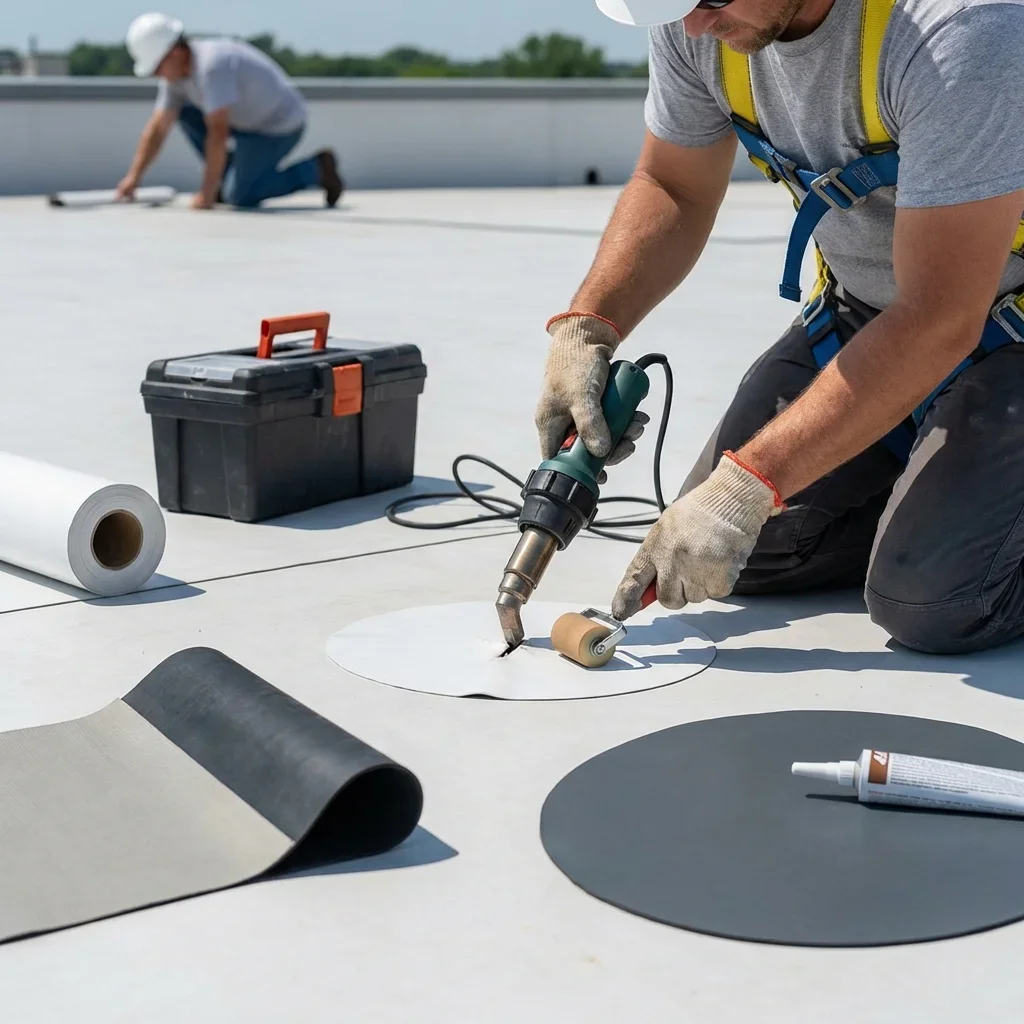
Damaged TPO membranes require heat-welding equipment to patch properly. You can't just slap adhesive over a puncture and call it fixed. Small holes (1-2 inches) get circular patches heat-welded in place. Larger damage requires cutting out the affected section and welding in a new piece with 6-inch overlaps on all sides.
That means emergency repairs often wait until a qualified contractor with proper equipment arrives.
Temporary patches using peel-and-stick materials will hold for a few days but won't survive Colorado's temperature swings or wind speeds.
TPO's seams rarely fail if installed correctly, but when they do, the fix is straightforward: re-weld the separation. The molecular bond can be reestablished as long as the membrane itself isn't too degraded. Contractors report TPO seam repairs holding as well as original installation.
EPDM Repairs
EPDM patches use adhesive or peel-and-stick tape, making field repairs simpler and faster. Most contractors carry EPDM repair materials on service trucks. A puncture or tear gets cleaned, primed, and patched in 15-30 minutes. That responsiveness matters when you're dealing with an active leak during a rainstorm.
EPDM's weak spot is seam maintenance.
Taped seams degrade over time, especially in Colorado's UV environment. Expect to re-inspect and potentially re-tape seams every 10-15 years. That's a $1,500-$3,000 maintenance item for a typical commercial building. Skipping it invites leaks. Liquid-applied EPDM adhesives hold longer but cost more upfront and require meticulous surface prep.
Both materials benefit from annual inspections and proactive maintenance. Flat roofs accumulate debris, develop ponding water, and suffer wind-blown damage that goes unnoticed until it becomes a leak. Professional inspection costs $200-$400 and typically includes minor repairs, debris removal, and drain clearing. All of which extend membrane lifespan regardless of material choice.
Learn more about roof maintenance programs that include flat roof coverage.
Warranty Coverage and Manufacturer Support
TPO manufacturers typically offer 15-20 year material warranties, with 25-30 year warranties available on premium membranes installed by certified contractors. Labor warranties depend on the installer. Expect 2-10 years depending on contractor reputation and certification level.
Manufacturer warranties are prorated, meaning coverage decreases each year. A 20-year warranty might cover 100% of material costs in year one but only 50% in year ten.
EPDM manufacturers offer similar warranty structures, but the material's longer track record often translates to better warranty fulfillment. Firestone's EPDM warranties are among the most reliable in the industry, with documented claims processing and reasonable exclusions. Some TPO manufacturers have been less consistent, particularly for membranes installed in the early 2000s when formulations were still evolving.
Both materials' warranties exclude damage from foot traffic, ponding water (standing water for more than 48 hours), and improper maintenance. In Colorado, hail damage typically isn't covered by manufacturer warranties. That's an insurance claim.
Read warranty documents carefully and verify the contractor installing your roof is certified to offer the warranty being promised. Uncertified installations may come with material-only coverage that leaves you paying full labor costs if problems develop.
Performance in Mountain Communities Above 8,000 Feet
Mountain towns like Breckenridge, Vail, and Aspen face challenges Front Range properties don't. Installation seasons compress to May-October due to cold temps and snow. Material transport costs add 15-25% to project pricing. Snow loads can exceed 100 pounds per square foot, requiring heavier structural support and thicker insulation layers.
EPDM's flexibility advantage becomes critical above 8,000 feet.
Overnight lows of -10°F to -20°F make TPO brittle. Thermal contraction stresses seams aggressively. EPDM remains pliable even in extreme cold, reducing seam failure risk. Multiple mountain contractors report near-universal preference for EPDM on high-altitude projects, citing long-term seam performance as the deciding factor.
TPO's reflectivity offers less benefit in mountain climates where heating loads exceed cooling loads. Black EPDM's heat absorption can actually reduce snow accumulation on flat roofs, helping prevent ice dam formation and reducing roof snow removal costs. That's a counterintuitive advantage in high-snow environments.
If your property sits above 8,000 feet, lean toward EPDM unless a commercial building operator needs maximum reflectivity for energy code compliance.
The material's proven performance in extreme cold outweighs TPO's efficiency advantages.
Which Material Wins for Colorado Applications?
There's no universal answer.
TPO delivers superior energy efficiency, stronger seam integrity when properly installed, and better long-term performance in high-UV environments. That makes it the better choice for most Front Range commercial buildings, retail centers, and new construction where contractors can control installation conditions.
EPDM's flexibility, proven longevity, puncture resistance, and cold-weather performance make it ideal for buildings on expansive clay soil, mountain properties above 8,000 feet, and projects where lower upfront cost outweighs long-term energy savings. It's also the safer choice when installation windows are tight or weather conditions marginal.
For flat roof installations on Denver-area commercial properties with experienced contractors and stable foundations, TPO's advantages justify the 15-25% cost premium. For residential additions, mountain homes, or buildings with documented foundation movement, EPDM's reliability and lower cost make more sense.
If you're replacing an existing flat roof after hail damage, review your insurance coverage carefully. Many policies reimburse for "like kind and quality" materials, meaning switching from EPDM to TPO or vice versa may require out-of-pocket upgrades.
The critical variable isn't the membrane. It's the contractor.
A skilled installer makes either material perform. An inexperienced one creates failures with both. Verify contractor credentials, request local references from projects at least five years old, and confirm they carry proper liability and workers' compensation insurance. Colorado's lack of state licensing requirements means due diligence falls entirely on you.
Get that part right, and the material choice becomes a manageable decision rather than a gamble.
Frequently Asked Questions
- International Code Council (Colorado Building Code). "Low-Slope Membrane Roof Assemblies." https://up.codes/viewer/colorado/irc-2018/chapter/9/roof-assemblies#9. Accessed April 08, 2026.
- International Code Council (Colorado Building Code). "Single-Ply Roof Membranes." https://up.codes/viewer/colorado/ibc-2018/chapter/15/roof-assemblies-and-rooftop-structures#1507.12. Accessed April 08, 2026.
- Colorado Roofing Association. "TPO/EPDM – Advanced." https://www.coloradoroofing.org/member/tpoepdm--advanced. Accessed April 08, 2026.
- National Roofing Contractors Association. "NRCA Roofing Manual: Membrane Roof Systems." https://www.nrca.net/technical-resources/roofing-manual. Accessed April 08, 2026.
- NRCA (National Roofing Contractors Association). "Single-Ply Roofing Guidelines." https://www.roofingcontractors.org/resources/roofing-technical-library. Accessed April 08, 2026.