
Identify Your Emergency Type First
Not all roof damage demands the same response. A wind-torn section with exposed decking requires different immediate action than a slow leak from displaced flashing. Before you do anything else, determine which category you're facing.
Structural compromise means visible sagging, large holes exposing rafters or trusses, or sections of roofing material completely missing. This is evacuate-and-call-911 territory if the damage threatens immediate collapse. Colorado's heavy spring snowpack combined with wind damage can overload weakened structures faster than you expect.
Hail damage often isn't obvious from ground level. You might see granule loss in gutters, dents on metal flashing, or cracked shingles. But the real damage is often hidden until water starts migrating through compromised adhesive strips.
Denver's 5,280-foot elevation means UV exposure has already weakened those bonds before hail hits.
Wind events (especially Chinook winds that hit 80+ mph along the Front Range) typically tear off ridge caps, lift shingle corners, or rip entire sections free. You'll see obvious material loss and possibly exposed underlayment. That's the black felt or synthetic barrier that's only a temporary weather barrier.
Ice dams and snow load damage show up as interior leaks during winter thaw cycles. Water backs up under shingles when melting snow refreezes at roof edges. Colorado's 60°F daily temperature swings in winter accelerate this cycle. You can go from frozen to melting to frozen again in 12 hours.
| Damage Type | Visibility | Immediate Risk | Response Timeline |
|---|---|---|---|
| Structural Compromise | Visible sagging, large holes | Collapse potential | Evacuate immediately |
| Hail Damage | Often hidden; granules in gutters | Water intrusion within days | 24-48 hours |
| Wind Damage | Obvious material loss, exposed underlayment | Water intrusion with next rain | Same day |
| Ice Dams/Snow Load | Interior leaks during thaw | Progressive water damage | 12-24 hours |
The First 15 Minutes: Safety and Containment
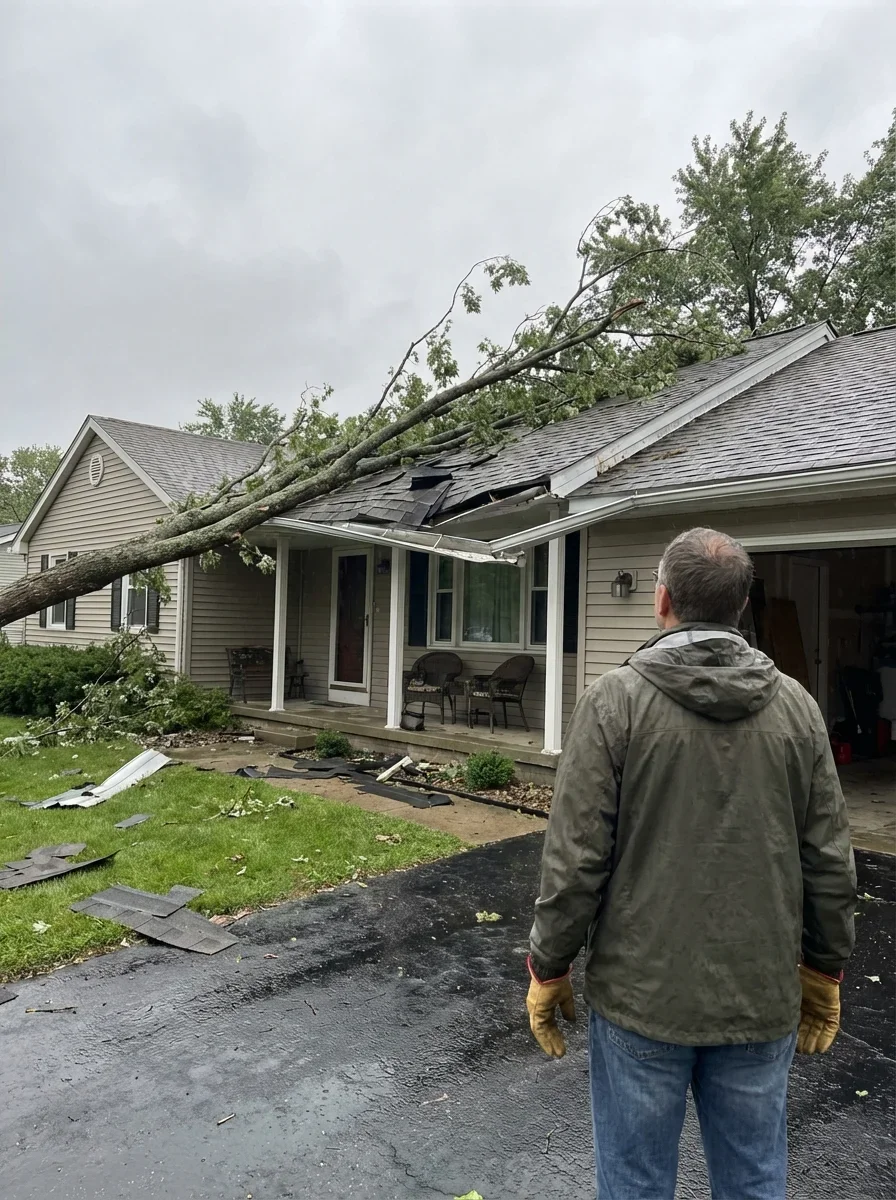
If you see downed power lines near your roof or touching your home, stay inside and call your utility company immediately.[2] Do not attempt any damage assessment. Xcel Energy's Front Range territory has underground and overhead lines. Windstorms can drop lines onto roofs without you seeing them from ground level.
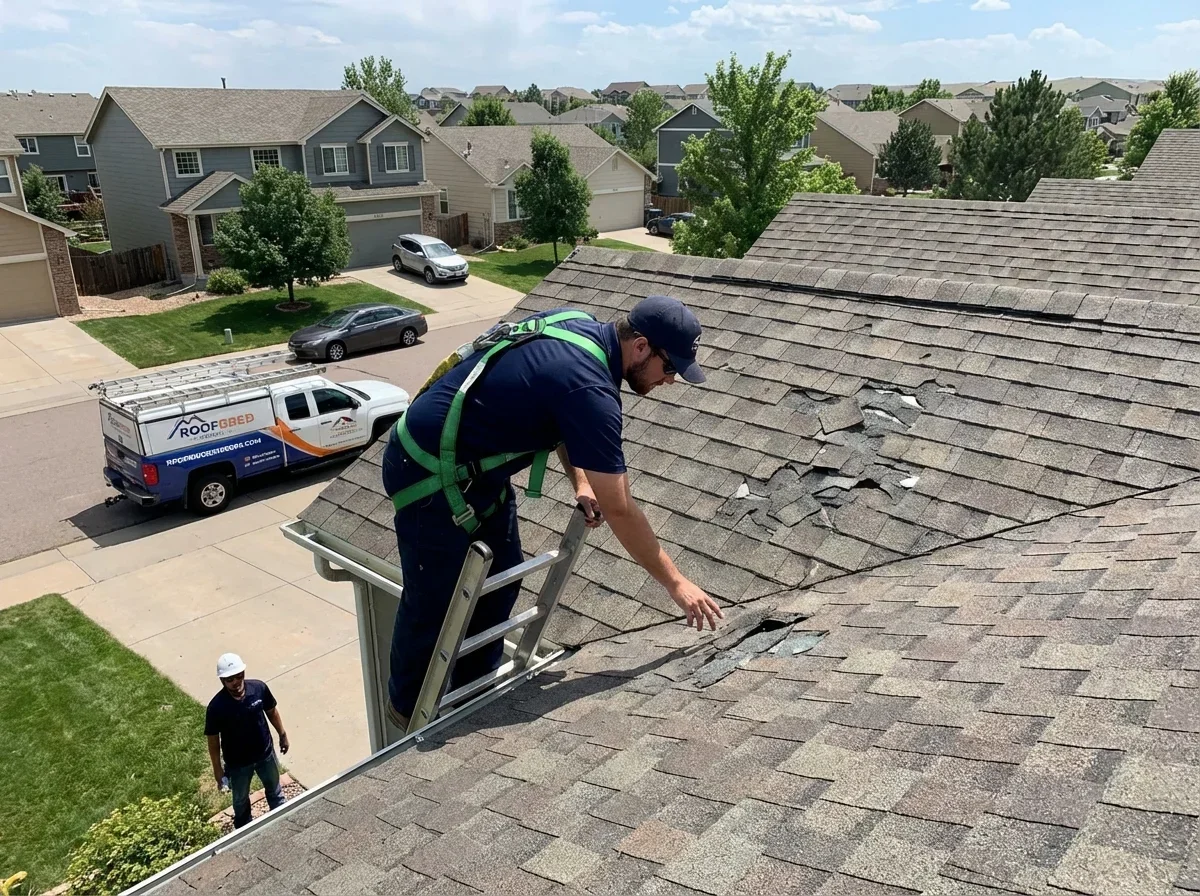
Never climb onto a damaged roof yourself. Colorado homeowners attempting post-storm inspections account for preventable injuries every hail season. Wet shingles at altitude, compromised decking, and adrenaline are a dangerous combination. Professionals carry fall protection, understand structural stability assessment, and have liability coverage you don't.
Stop Active Water Intrusion
If water is entering your home, containment is your only immediate action. Place buckets, towels, or tarps under active drips. Move electronics, furniture, and anything water-sensitive away from the affected area.
Don't try to patch the roof from inside. You're just buying time until a professional arrives.
For attic leaks, place a bucket and poke a small drain hole in any bulging ceiling areas to relieve pressure. Pooled water in drywall or plaster will spread and cause more damage than a controlled drain point. Document everything with photos as you go.
If you have accessible attic space and can identify the general leak location, mark it with chalk or a photo so contractors can find it quickly. Colorado's architectural shingle installations often have multiple layers of underlayment in high-wind zones. Water can travel several feet horizontally before dripping into living space, making source identification tricky.
Document Everything (The Insurance-Proof Method)
Your documentation quality directly impacts your insurance settlement. Colorado averages 7+ significant hail events per year along the Front Range corridor, which means adjusters see hundreds of claims after major storms.
Generic photos won't differentiate your legitimate damage from normal wear.
Take photos from multiple angles: ground-level shots showing overall roof condition, close-ups of damaged shingles (with ruler or coin for scale), gutters full of granules, dents on metal vents and flashing, and any interior water stains. Shoot video walking the perimeter of your home narrating what you see. "Northeast corner, approximately 15 shingles with visible creasing, installed 2019 per permit records."
Timestamp everything. Note the date, time, and weather conditions in your photos' metadata or a written log. Colorado's multiple hail zones (Denver, Colorado Springs, Fort Collins all have distinct storm patterns) mean your insurance company will cross-reference your claim against NOAA hail reports. A mismatch between your damage photos and actual storm dates raises red flags.
What Adjusters Actually Look For
Hail damage on asphalt shingles shows as circular dents with visible mat fiber (the underlying fiberglass), cracked or missing granules in a concentrated pattern, and shiny "bruise" spots where impact compressed the asphalt. Normal aging creates uniform granule loss. Hail creates random, impact-centered patterns.[1]
Wind damage appears as lifted or creased shingles, missing ridge caps, torn drip edge, or nail pops where fasteners pulled through the material. Colorado's Class 4 impact-resistant shingles (increasingly standard after 2015) have better wind ratings but can still fail in 80+ mph Chinook events.
Photograph your gutters. Granule accumulation tells adjusters about shingle age and hail impact severity. A roof installed in 2018 shouldn't have significant granule loss unless hail accelerated degradation.
Denver's UV exposure already shortens shingle life 25-30%. Hail compounds that.
Essential Documentation Checklist:
- Multiple-angle photos with ruler/coin for scale
- Video walkthrough with narrated damage description
- Timestamped images matching NOAA storm reports
- Gutter photos showing granule accumulation
- Interior water stain documentation
- Before-and-after comparisons if available
- Written damage log with dates and observations
Secure Temporary Protection (When It's Safe)
If you can access the damaged area safely from inside your attic, you can place a tarp over the leak point from the interior side as a stopgap. Do not attempt exterior tarping yourself. Colorado roofs are steeper than national averages (6/12 to 8/12 pitch common for snow shedding), and damaged decking won't support your weight reliably.
Professional emergency tarping services operate 24/7 in metro Denver, Colorado Springs, and Front Range communities. Expect $300-800 depending on roof access, damage extent, and weather conditions.
This cost is typically reimbursable through insurance as part of emergency mitigation.
Tarping and Permit Reality
Many homeowners don't realize that tarping damaged roofs before professional assessment can complicate insurance claims if done incorrectly. Adjusters need to see original damage. If your tarp obscures hail dent patterns or wind-torn sections, they may reduce settlements.
Photograph before any tarping, even emergency measures.
Colorado building codes don't require permits for temporary weather protection, but any repair work does. Denver requires permits when roof repairs exceed 10% of total square footage or two squares (whichever is smaller) for buildings under 25,000 square feet.[3] Pueblo's regulations allow repairs under 100 square feet without permits, but full replacements always need inspection.[4]
If your roof already has two or more layers of shingles (common on pre-2000 Front Range homes), Denver code mandates complete tear-off to decking before any new installation. You can't just patch over existing layers even in emergency situations.
Contact Your Insurance Company Within 24 Hours
Colorado insurance policies typically require "prompt" damage notification. Most define this as 24-72 hours after discovery. Waiting weeks to file a claim can trigger denial based on failure to mitigate further damage, which is your contractual obligation.[1]
When you call, provide your documentation immediately: photo timestamps, weather event details, and a preliminary damage description. Don't estimate repair costs. That's the adjuster's job.
Do emphasize any active water intrusion or structural concerns that require emergency response.
What Colorado Adjusters Won't Tell You
Insurance companies increasingly push Class 4 impact-resistant shingle replacements (offering 15-28% premium discounts) even when your existing roof was standard architectural shingles. This is beneficial long-term in Colorado's hail corridor, but verify that your policy covers the upgrade cost differential.
Some policies only cover "like-for-like" replacement unless you pay the difference.
Deductibles have risen significantly. Many Colorado homeowners now carry 1-2% of home value deductibles specifically for wind/hail damage. On a $550,000 median-value Front Range home, that's $5,500-11,000 out of pocket before insurance pays. Factor this into your emergency response decisions.
Major hail events create 12-18 month repair backlogs. After the 2023 Boulder County storm, local contractors were booking 6+ months out by August. Filing your claim within 24 hours gets you in queue before the backlog compounds.
Florida homeowners report that insurers often delay or underpay claims after large-scale disasters when adjusters are overwhelmed. Colorado sees the same pattern after significant Front Range hail events.
Find Emergency Repair Contractors (Not Storm Chasers)
Out-of-state contractors flood Colorado neighborhoods within 48 hours of major hail. They knock doors, offer "free inspections," and push immediate contract signing with pressure tactics.
Some are legitimate. Many are not.
Verify local licensing first. Colorado doesn't require state-level roofing licenses, but municipalities do. Denver, Aurora, Colorado Springs, Boulder, Fort Collins, and Lakewood all have distinct contractor registration requirements. Check with your city building department or visit colorado.gov/dora to verify business registration and insurance status.
Ask for references from projects completed in the last 12 months, not just testimonials on their website. Call those homeowners. Ask about project timeline, permit compliance, warranty follow-through, and whether the company responded to post-installation issues. A Southern Indiana homeowner signed a contract with Lexington Blue in October after storm damage, only to discover the company never completed work and became unresponsive. The contract allowed the company to retain 15% of the estimate after a 5-day cancellation window.
PRO TIP: Legitimate emergency roofing contractors will never pressure you to sign a contract on the spot. They understand that post-storm decisions require careful consideration, and they'll still be in business next week because they have a physical office, not just a temporary phone number.
Contract Red Flags Colorado Homeowners Miss
Never sign a contract that requires upfront payment exceeding 10% of project cost. Colorado contractors working through insurance restoration typically don't need large deposits. They collect from your insurance company upon completion.
Read the work timeline clause carefully. "4-6 weeks or longer" isn't specific enough. Demand a start date and substantial completion date in writing.
Post-storm contractor availability is legitimately limited, but vague timelines protect contractors, not you.
Ensure the contract specifies permit responsibility. In Colorado's patchwork licensing landscape, contractors sometimes skip permits to expedite work. This voids manufacturer warranties, creates code violations, and complicates future insurance claims. Your contract should state: "Contractor will obtain all required municipal permits and schedule required inspections."
Handle the 72-Hour Window
Once immediate safety and documentation are complete, you're in the critical decision window. Insurance adjusters typically schedule visits within 3-7 days in non-disaster scenarios, faster if you emphasize active water intrusion.
Use this time strategically.
Get at least three repair estimates from licensed local contractors. Colorado's lack of state licensing means contractor quality varies dramatically. Three estimates give you pricing context and approach differences. Beware of estimates that vary by more than 30% without clear material or scope explanations.
Permit Requirements by Damage Type
Minor repairs (replacing a few shingles, resealing flashing) under 100 square feet typically don't require permits in Pueblo and similar jurisdictions, though you should verify with your specific municipality.[4] Anything larger enters permit territory.
Full roof replacements always require permits and at least one final inspection in Colorado municipalities. Denver requires just one inspection for asphalt re-roofs, after completion, which streamlines the process compared to other jurisdictions.[3] However, if your existing roof has multiple layers, expect more stringent inspection of the tear-off and decking condition.
Mountain communities above 8,000 feet often have additional snow load and fire rating requirements. Wildfire-risk zones along the foothills mandate Class A fire-rated roofing. Cedar shake is banned in many areas since the Marshall Fire. If you're replacing damaged roofing in these zones, your contractor must navigate both standard building codes and fire district regulations.
Prevent Escalating Damage While You Wait
Colorado's 60°F daily temperature swings mean damage worsens faster than in stable climates. A small flashing separation becomes a water intrusion point when afternoon snowmelt refreezes overnight, expanding cracks and loosening more material.
Monitor your attic daily for new water stains, increased drips, or wet insulation. What starts as a minor leak during a March storm becomes a saturated insulation problem by April's heavier precipitation.
Wet insulation loses R-value and promotes mold growth. Colorado's dry climate helps, but trapped moisture in enclosed attic spaces still creates problems.
Interior Protection Priorities
Move valuables and electronics away from affected areas entirely, not just under tarps. Water migration paths change as temperatures fluctuate. A leak in your northwest bedroom during yesterday's rain might shift to the closet during today's snowmelt cycle.
If you have accessible attic space, increase ventilation to help moisture evaporate. Open attic vents (if safe and weather permits) or run fans to promote air circulation. Don't use dehumidifiers without professional guidance. In Colorado's dry climate, you're usually fighting localized moisture, not whole-house humidity.
Photograph any new damage progression weekly. If your contractor's timeline slips (common in post-storm backlogs) or your insurance company questions claim severity, this documentation proves damage escalation and supports additional compensation.
What Is Emergency Roof Repair? (And What Isn't)
Emergency roof repair addresses immediate threats: stopping active water intrusion, securing blown-off sections, stabilizing compromised structures, and preventing injury from falling debris.
It's short-term intervention, not permanent restoration.
In Colorado's regulatory framework, emergency repairs fall under disaster response provisions. The Colorado Disaster Emergency Act defines disasters as imminent threats of severe property damage from natural causes, enabling emergency response to storm events.[8] This legal framework allows expedited permitting in declared disaster zones, though individual municipalities still control implementation.
What emergency repair isn't: full replacements, cosmetic fixes, or addressing pre-existing conditions discovered during storm damage assessment. If your 2008 roof had granule loss before the hail hit, insurance won't cover that portion. They'll cover new hail impact damage only.
The Repair vs. Replace Decision
Colorado's insurance market increasingly pushes full replacements over repairs after significant hail damage, even when functional repairs are possible. Adjusters know that a 12-year-old roof with hail damage will likely claim again in 2-3 years given Front Range hail frequency. Replacing now with Class 4 shingles reduces their long-term liability.
You might prefer repair to preserve your deductible for future incidents. Or you might want full replacement to upgrade to impact-resistant materials.
Neither choice is wrong, but understand the trade-offs.
A repair keeps your existing roof's warranty active (if any remains) but doesn't address age-related degradation. Replacement costs more upfront but provides 20-30 year coverage with better hail resistance.
For detailed guidance on this decision specific to Colorado's climate and insurance environment, see When to Repair vs Replace Your Roof in Colorado.
Navigate Colorado's Unique Insurance Landscape
Colorado Division of Insurance oversees homeowner insurance disputes, but the claims process itself runs through private insurers with varying claim handling quality. Post-storm claim volumes spike 300-400% after major Front Range hail events.
Your adjuster is juggling 50+ files simultaneously.
This volume creates delays, underpayments, and occasional denials of valid claims. Document everything in writing. If your adjuster visits and provides a verbal estimate, request written confirmation within 48 hours. If they deny coverage for portions of damage, ask for denial reasoning in writing with specific policy language cited.
When to Escalate or Get Help
If your insurance company delays beyond 30 days without clear timeline communication, file a complaint with Colorado Division of Insurance. If they underpay based on clear documentation of storm damage, consider hiring a public adjuster who works for you, not the insurance company. They typically charge 10-15% of settlement but can increase payouts by 20-40% in disputed claims.
Florida homeowners report that legal assistance is sometimes necessary to secure fair settlements after hurricanes. Colorado sees similar patterns after widespread hail damage.
If your claim exceeds $15,000 and you're getting pushback, a consultation with an insurance attorney (many offer free initial reviews) can clarify whether you're being treated fairly.
For comprehensive guidance on Colorado's insurance claim process, including documentation requirements and common pitfalls, see Colorado Roof Insurance Claims: A Complete Guide.
Is a Leaking Roof an Emergency?
It depends on the leak volume, location, and threat to safety. A slow drip into a bucket in your garage isn't life-threatening. It's urgent, not emergency-level.
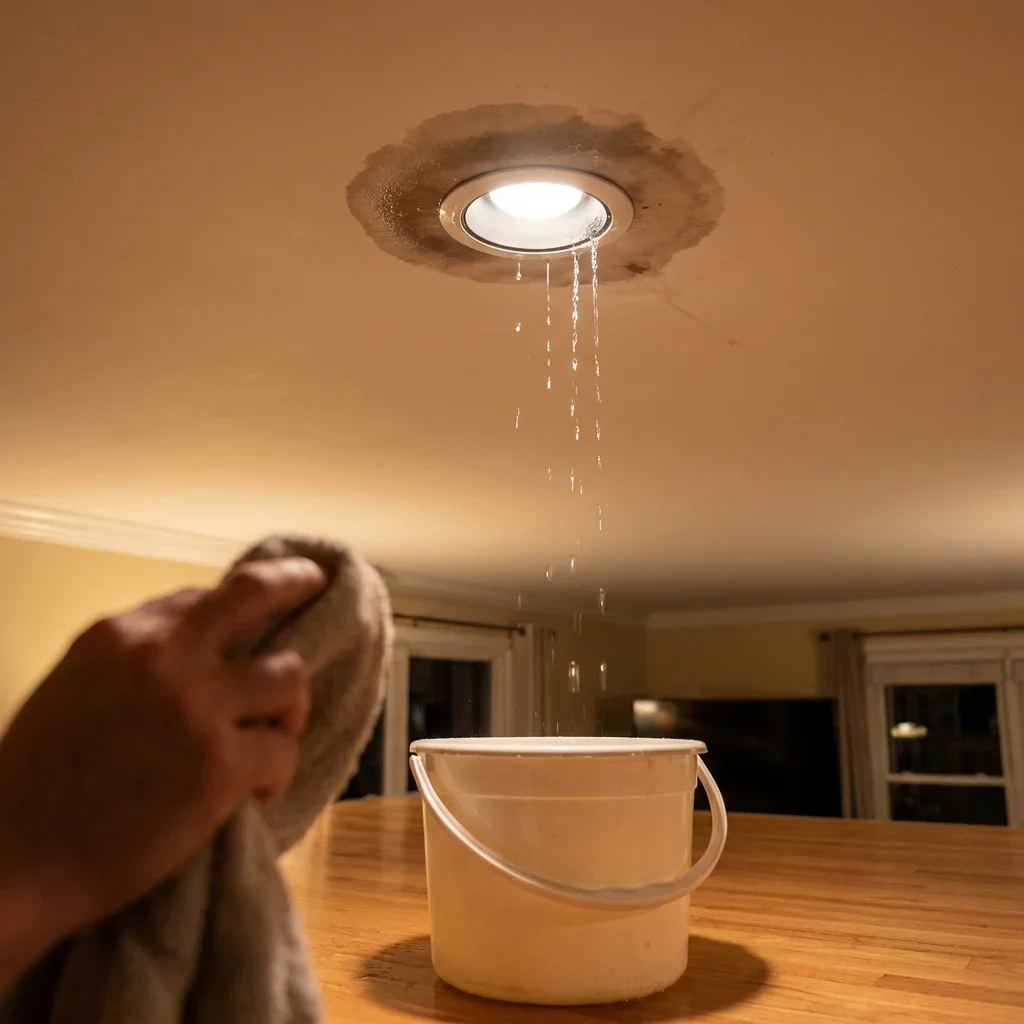
Water pouring through a light fixture into your kitchen where electrical outlets are located is a genuine emergency requiring immediate power shutoff and professional response.
Colorado's electrical codes require GFCI protection in many areas, but older homes (especially Denver's pre-1970 bungalows and Victorians) may not have updated wiring. Water and electricity create electrocution hazards that escalate faster than structural damage.
Triage Your Response Based on Leak Severity
Minor leak (slow drip, contained): Document, contain with bucket/towels, call contractor during business hours for assessment within 24-48 hours. This isn't ideal, but you're not facing immediate escalation if you monitor daily.
Moderate leak (steady flow, spreading stain): Document, contain as much as possible, call emergency roofing services immediately for temporary protection. This will worsen with the next precipitation event. Colorado's variable weather means you might get lucky with a dry week, or you might get hit with another storm in 48 hours.
Severe leak (pouring water, electrical hazard, ceiling bulging): Document quickly, shut off electricity to affected areas, evacuate if structural failure seems imminent, call 911 if immediate danger exists.
This is the scenario where emergency tarping and professional assessment can't wait.
After significant flooding, Colorado Water Conservation Board guidelines require communities to ensure building sites are reasonably safe from future flooding, conduct inspections for compliance, and require new construction elevated above base flood levels.[1] If your emergency roof damage resulted from or contributed to flooding, expect additional inspection requirements during repair.
Long-Term Prevention After the Emergency
Once repairs are complete, Colorado homeowners should implement twice-yearly inspection schedules: spring (March-April before hail season) and fall (September-October before winter). These inspections catch minor issues before they become emergency situations.
Keep gutters clean year-round. Colorado's Front Range cottonwoods and pines shed debris that clogs gutters, creating ice dam conditions in winter and water backup during spring runoff. Clogged gutters contributed to roof damage in multiple homeowner accounts.
It's a simple maintenance item that prevents expensive problems.
Material Choices for Future-Proofing
If you're replacing your roof after emergency damage, strongly consider Class 4 impact-resistant shingles. Colorado's hail frequency makes this a financial decision, not just a quality preference. The 15-28% insurance discount pays for the material upgrade in 7-10 years, and you avoid repeat emergency scenarios.
Metal roofing is growing in mountain communities for snow shedding and fire resistance, but requires UV-resistant finishes due to Colorado's intense sun exposure at elevation. Standard metal roofing paint fades 30-40% faster at 8,000+ feet than at sea level.
Synthetic slate and shake products offer fire ratings that natural materials can't match. Critical in Colorado's wildfire interface zones. The Marshall Fire's aftermath pushed many foothill communities to mandate Class A fire ratings, effectively banning traditional cedar shake that was common on mountain homes built before 2000.
For a detailed comparison of roofing materials suited to Colorado's specific climate challenges, see Colorado Roofing Materials: Which Is Best for Your Climate?.
How Do You Describe a Damaged Roof for Insurance Claims?
Use specific, measurable language. "The roof is damaged" gets you nowhere.
"17 architectural shingles on the south-facing slope show circular impact dents 0.5-0.75 inches in diameter with visible mat fiber, consistent with 1-inch hail reported by NOAA on June 15, 2026" gives adjusters actionable information.
Reference specific roof components by name: ridge caps, drip edge, valley flashing, step flashing, soffit vents, turbine vents. General terms like "the metal parts" or "the edges" suggest you don't understand roof anatomy. Adjusters may question whether damage is real or imagined.
Visual Documentation Standards
Colorado adjusters increasingly use drone and satellite imagery to verify claims before scheduling in-person visits. Your ground-level photos should match aerial perspectives. If you claim damage to your north-facing slope but satellite imagery from the day after the storm shows intact shingles, your claim credibility suffers.
Include photos of your neighbors' roofs if they have similar damage. Widespread hail impact across multiple properties in your subdivision strengthens your claim. It's clearly a weather event, not isolated deterioration.
Don't trespass to get these photos, but public street views are fair game.
Take photos of hail stones if any remain after the storm (next to a ruler or quarter for scale). Colorado hail melts quickly in summer sun, but you might find preserved hailstones in shaded areas, under bushes, or in protected porch corners even hours after the event.
Emergency Roof Repair Services: Finding 24/7 Help
Legitimate emergency roofing services in Colorado operate through established businesses with physical offices, not just phone numbers and websites created the day after a storm. Metro Denver, Colorado Springs, and Fort Collins all have local contractors offering genuine 24/7 emergency response. They're licensed, insured, and have been in business for years, not weeks.
Call your municipality's building department and ask for their list of registered roofing contractors. Most maintain updated lists and can tell you if a contractor has active permits, passed recent inspections, or has code violations on file.
This takes 5 minutes and filters out storm chasers.
Emergency Service Pricing Reality
Expect to pay 30-50% premiums for after-hours emergency response (nights, weekends, holidays). A $500 emergency tarping job during business hours might cost $750 at 11 PM on Sunday.
This is standard practice. Emergency response requires on-call staff and immediate material availability.
Verify that emergency services are insurance-reimbursable before authorizing work. Most Colorado insurance policies cover reasonable emergency mitigation, but "reasonable" is subjective. A $2,000 emergency tarping bill for a 1,500-square-foot ranch house will raise adjuster questions. Get multiple quotes if time allows.
For contractors specializing in emergency response and storm damage across Colorado, see Emergency Roof Repair and Storm Damage Roof Repair. For free damage assessments specific to hail impacts, see Free Roof Inspections & Hail Damage Assessments.
What Can Cause Roof Damage in Colorado's Climate?
Hail is the dominant cause. Front Range counties average 7+ significant hail events per year, with some neighborhoods experiencing multiple damaging storms in a single season. One-inch hail (the threshold for likely shingle damage) occurs dozens of times annually along the I-25 corridor from Fort Collins through Denver to Colorado Springs.
Wind events, particularly Chinook winds, hit 80-100 mph in exposed areas. These downslope windstorms occur year-round, not just during spring storms.
They create rapid barometric pressure changes that lift shingles sealed by Colorado's temperature extremes. Morning ice, afternoon heat, evening cooling stresses adhesive bonds.
Less Obvious Damage Sources
Ice dams form when Colorado's intense winter sun melts snow on south-facing slopes while north-facing slopes remain frozen. Meltwater runs to colder eaves, refreezes, and backs up under shingles. The 60°F daily temperature swings during winter accelerate this cycle. You can form, melt, and re-form ice dams multiple times per week.
UV degradation at altitude acts as a force multiplier for other damage. Denver's elevation means 50%+ more UV radiation than sea level. This breaks down asphalt binder and loosens granules before hail or wind ever hits.
A 20-year shingle might last 14-15 years in Colorado even without storm damage.
Expansive clay soil along the Front Range causes foundation movement that shifts rooflines and breaks flashing seals. This isn't sudden damage like storms, but gradual structural shifting that creates leak points. Many Denver-area homeowners discover this during roof replacement when contractors find broken step flashing that's been leaking slowly for years.
For specific guidance on identifying different types of damage, see Signs of Hail Damage on Your Roof and Ice Dams in Colorado: Causes, Prevention, and Repair.
Your Post-Emergency Action Plan
Within 24 hours: Document damage thoroughly, contact insurance company, secure temporary protection if needed, and begin vetting contractors through municipal licensing verification.
Within 72 hours: Get multiple repair estimates from licensed local contractors, understand your insurance policy deductible and coverage limits, and create a written timeline for repair completion with your chosen contractor.
Long-Term Recovery Checklist
Schedule follow-up inspections at 30, 60, and 90 days post-repair to verify work quality and catch any warranty issues early. Colorado contractors offering workmanship warranties (typically 2-10 years depending on company) can only honor them if you identify problems before time expires.
Update your home maintenance records with repair dates, materials used, and permit numbers. Future insurance claims and home sales both benefit from documented repair history.
Colorado's real estate disclosure laws require sellers to report known roof issues. Having professional repair documentation protects you from liability.
Consider professional Roof Maintenance Programs & Annual Service Plans that include twice-yearly inspections and minor repairs. Colorado's hail frequency and UV exposure make preventive maintenance more cost-effective than emergency repairs every few years.
The roof damage you're facing right now feels overwhelming. But you've taken the most important step: learning what to do before panic drives poor decisions.
Colorado homeowners who document thoroughly, verify contractors carefully, and understand their insurance policies navigate emergencies far better than those who rush into the first available solution.
Frequently Asked Questions
- Colorado Water Conservation Board (State of Colorado). "Attachment E - Quick guide to Floodplain Management in Colorado." https://dnrftp.state.co.us/CWCB/CO_Attach/Attachment%20E%20-%20Quick%20guide%20to%20Floodplain%20Management%20in%20Colorado.pdf. Accessed April 08, 2026.
- City and County of Denver Community Planning and Development. "Roofing Guide and Checklist." https://denver.prelive.opencities.com/files/assets/public/v/4/community-planning-and-development/documents/ds/inspections/roofing_guidelines_and_checklist.pdf. Accessed April 08, 2026.
- Pueblo Regional Building Department (Colorado). "Do You Have Roof Damage From a Storm? Here's What You Need ...." https://www.pprbd.org/File/ByAlias/RoofingHomeowners. Accessed April 08, 2026.
- Colorado Secretary of State (Code of Colorado Regulations). "2 CCR 408-1 - Code of Colorado Regulations." https://www.sos.state.co.us/CCR/GenerateRulePdf.do?ruleVersionId=9963&fileName=2+CCR+408-1. Accessed April 08, 2026.
- Colorado General Assembly (State Statutes). "Emergency Management (Colorado Revised Statutes Annotated: Title 24 ...)." https://faolex.fao.org/docs/pdf/us196438.pdf. Accessed April 08, 2026.