
What Causes Ice Dams in Colorado
Ice dams form when heat escaping from your attic melts snow on your roof's upper sections. The meltwater runs downslope until it reaches your eaves, which stay below freezing because they overhang the exterior walls without heat transfer from the house. When that meltwater refreezes at the eave line, it creates a growing ice ridge that blocks further drainage.
Colorado's climate makes this worse. A sunny 55°F afternoon can drop to 5°F overnight. That temperature swing melts daytime snow, then freezes it solid before it drains.
You'll see ice dams most often after 6+ inches of snowfall followed by sunny days and cold nights, especially in January through March when we get heavy snow but strong solar radiation at 5,280 feet.
Why Colorado Homes Are Vulnerable
Attic insulation in pre-1990 Colorado homes often falls short of current R-49 standards. Many Denver bungalows and ranch homes have R-19 or less, allowing significant heat loss through the roof deck.
Poor attic ventilation compounds the problem. Homes built before modern soffit-to-ridge ventilation standards trap warm air that melts roof snow from below.
The Front Range's expansive bentonite clay soil creates another risk factor. Seasonal moisture changes cause foundations to shift, which stresses roof structures and breaks flashing seals along valleys and eaves. Once flashing separates even slightly, ice dams push water through gaps that would normally shed moisture safely.
Pro Tip: If you live in a pre-1990 Colorado home, check your attic insulation level now—before winter hits. Most ice dam problems start with inadequate insulation (R-19 or less) that allows heat to escape and melt roof snow from below. Upgrading to R-49 eliminates the temperature differential that creates ice dams in the first place.
How Ice Dams Damage Your Roof and Home
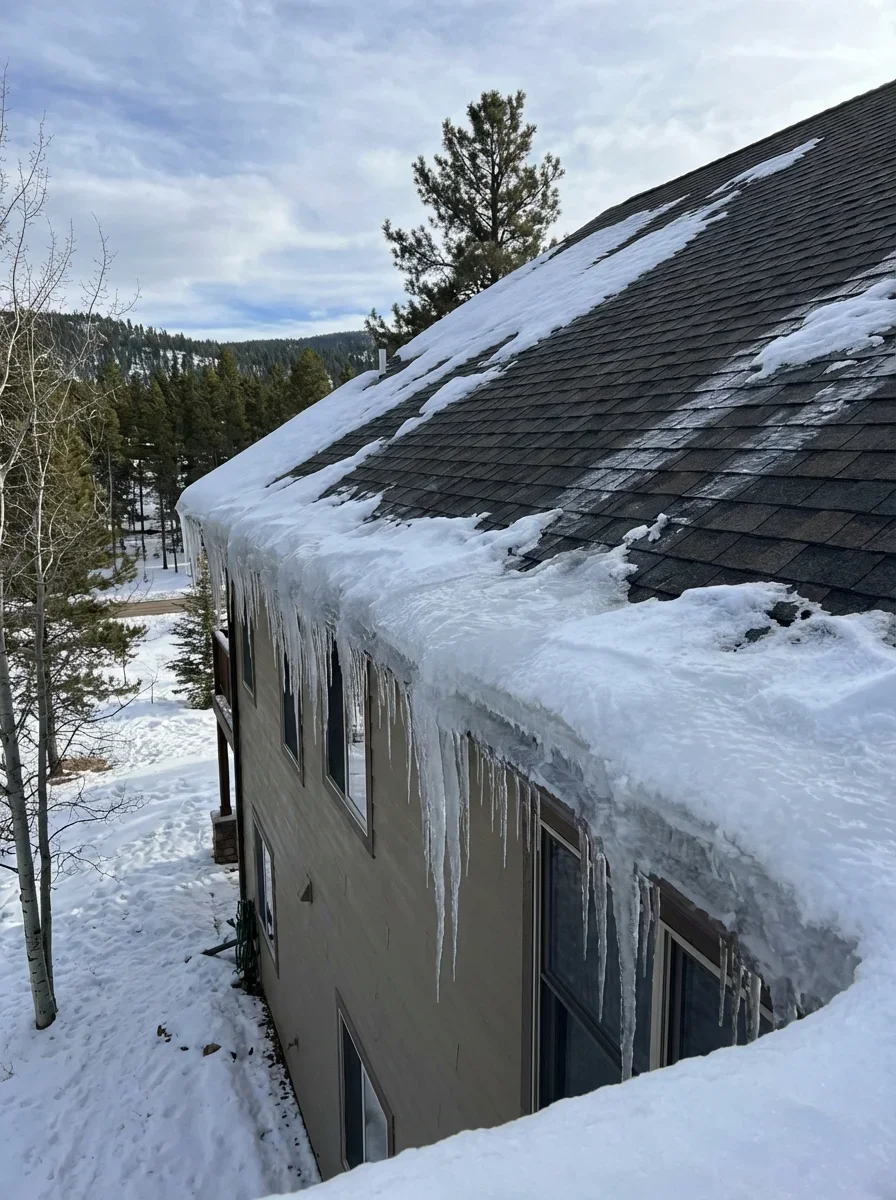
Ice dams force water backward under your shingles because the ice ridge blocks normal downslope drainage. Asphalt shingles are designed to shed water moving downward by gravity, not water pooling behind an ice barrier.
When meltwater backs up under shingle edges, it seeps through nail holes, saturates underlayment, and drips into your attic.
Water damage shows up first as ceiling stains in upper-floor rooms or along exterior walls. You might see drips hours after the sun hits your roof, or notice water running inside exterior walls. Insulation soaks up water like a sponge, losing R-value and creating conditions for mold growth within 48 hours.
Prolonged ice dam exposure can rot roof decking and fascia boards. Mountain homes above 8,000 feet see the worst structural damage because ice dams persist for weeks during extended cold snaps, giving water time to penetrate deeper into roof assemblies.
By the time you notice interior damage, the hidden rot may already require deck replacement in addition to shingle repairs.
Insurance Coverage and Claims in Colorado
Homeowner's insurance in Colorado typically covers water damage caused by ice dams as a covered peril, but coverage varies by policy. Standard policies cover interior damage and emergency repairs, but may not pay for preventive work like additional insulation or ventilation upgrades that would stop future ice dams.
Many Colorado homeowners carry 1-2% deductibles for wind and hail. Those same deductibles apply to ice dam water damage claims. On a $550,000 home (Colorado's 2026 median), you're paying $5,500 to $11,000 out of pocket before coverage kicks in.
Review your policy's water damage exclusions and consider documenting ice dam conditions with photos before interior leaks occur, as some carriers dispute claims when maintenance issues contribute to damage.
Building Code and Underlayment Requirements
Colorado's adoption of the International Residential Code (IRC) sets minimum standards for roof assemblies, but local jurisdictions interpret ice dam protection differently. The City of Arvada does not require additional underlayment like ice and water shield for ice dams as a general rule due to lack of widespread history, but enforces manufacturer requirements per 2018 IRC R905.1.[1]
Most shingle manufacturers require ice and water shield underlayment extending 24 inches inside the exterior wall line in areas where historical ice dam conditions exist. That creates a gray area in Colorado. We don't have the persistent ice dam history of Minnesota or New England, but Front Range temperature swings create episodic high-risk conditions.
Contractors working in Evergreen, Nederland, or other mountain communities routinely install ice and water shield even when local code doesn't mandate it, because altitude and sustained cold make ice dams predictable.
Municipality Variations
Denver, Boulder, and Fort Collins generally follow manufacturer underlayment specifications without adding ice dam-specific requirements beyond IRC minimums. Colorado Springs and Aurora allow permit-exempt minor repairs under dollar thresholds, but full reroofing triggers manufacturer warranty compliance including underlayment standards.
Mountain communities with sustained sub-freezing winters often adopt stricter standards informally. Building inspectors in Summit County and Eagle County expect to see ice and water shield during plan review even when code doesn't explicitly require it.
If you're reroofing in Colorado, verify local requirements at your municipal building department and confirm your contractor's plan meets both code minimums and manufacturer warranty conditions.
Preventing Ice Dams: Insulation and Ventilation
Stopping ice dams means keeping your roof deck cold so snow doesn't melt prematurely. Attic insulation rated to R-49 (the current IRC standard for Colorado's climate zones 5B and 6B) reduces heat loss through the ceiling plane. That keeps attic temperatures closer to outdoor ambient, eliminating the temperature differential that melts roof snow.
Ventilation works alongside insulation. Continuous soffit intake vents paired with ridge vents create airflow that exhausts any warm air reaching the attic before it heats the roof deck.
Aim for 1 square foot of net free ventilation area per 150 square feet of attic space, with intake and exhaust balanced 50/50. Many 1970s-1990s Colorado homes have inadequate soffit vents or blocked airflow from insulation pushed too far into eave spaces.
Air Sealing the Attic Floor
Insulation alone won't stop ice dams if warm air bypasses it through gaps. Recessed light fixtures, bathroom exhaust fans, plumbing stacks, and attic access hatches all leak conditioned air into attic spaces.
Seal those penetrations with fire-rated caulk or expanding foam before adding insulation.
Whole-house attic fans popular in 1980s Colorado construction can worsen ice dams by pulling warm indoor air into the attic during winter operation. If you have an attic fan, seal the shutter box tightly or disconnect it during heating season. The same goes for poorly sealed furnace flues and ductwork running through unconditioned attic space. Seal joints with mastic and wrap ducts with insulation to prevent radiant heat transfer to the roof deck.
Quick Ice Dam Prevention Checklist:
- Upgrade attic insulation to R-49 minimum
- Install continuous soffit-to-ridge ventilation (1 sq ft per 150 sq ft attic space)
- Seal all attic floor penetrations with fire-rated caulk or foam
- Disconnect or seal whole-house attic fans during winter
- Wrap and insulate exposed ductwork in attic spaces
- Clear gutters in October and December before heavy snow
Safe Ice Dam Removal Methods
Never chip ice dams with a hammer, ice pick, or shovel. Asphalt shingles become brittle in freezing temperatures, and impact damage from metal tools creates punctures that leak long after the ice melts. You'll also risk tearing off shingle tabs, breaking sealant bonds, and cracking flashing.
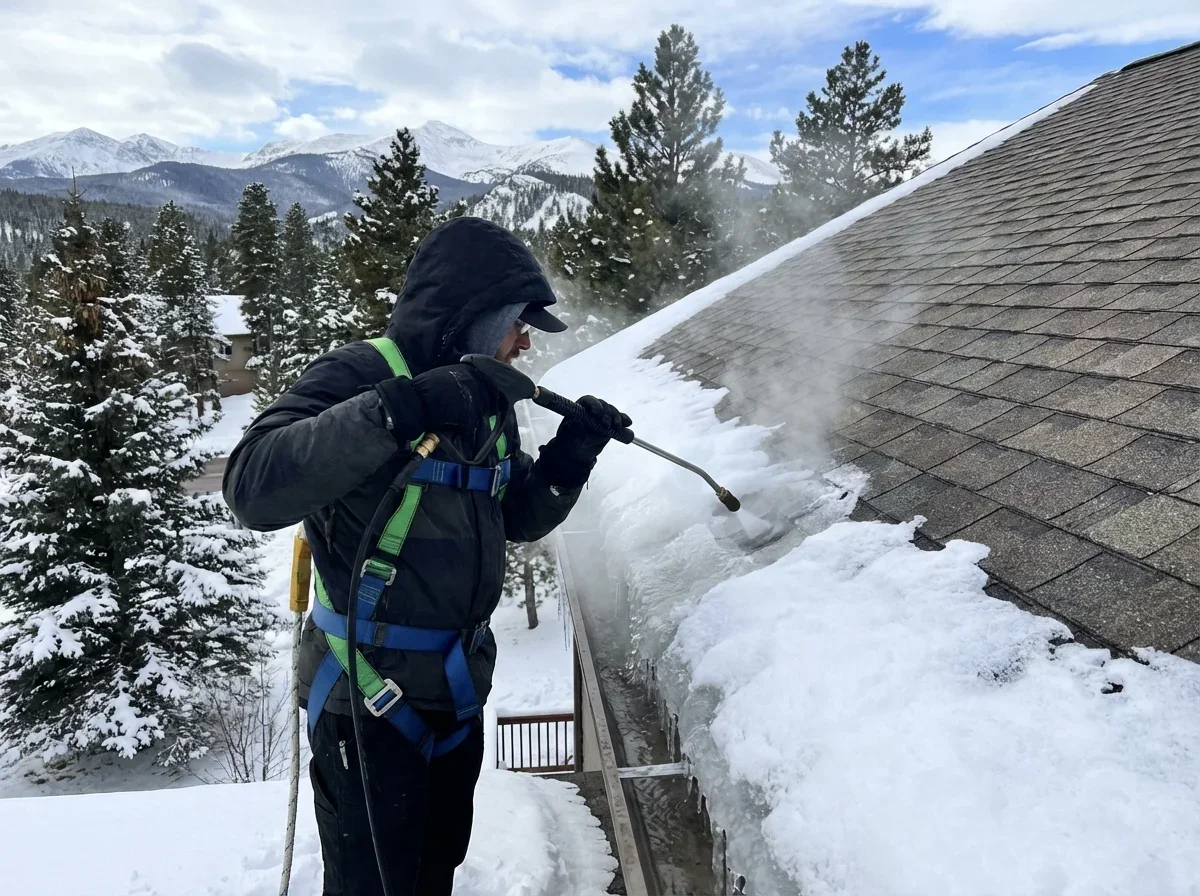
Steam melting uses low-pressure steam to cut channels through ice dams without damaging shingles. Professional roof contractors in Colorado charge $300-$600 to steam-melt ice dams on a typical residential roofline, creating drainage paths that relieve water backup.
The process takes 1-3 hours depending on ice thickness and roof complexity.
Calcium Chloride Ice Melt Socks
Fill nylon stockings or tube socks with calcium chloride ice melt (not rock salt, which corrodes metal and harms plants), tie off the ends, and lay them vertically across the ice dam. The calcium chloride melts through the ice over 6-12 hours, creating channels for water drainage.
This method works for minor ice dams and costs under $20 in materials, but it's slow and requires roof access.
Don't use rock salt or sodium chloride blends. They damage shingles, gutters, and landscaping. Place socks perpendicular to the roofline so meltwater runs straight down into gutters rather than spreading laterally along the dam.
Temporary Emergency Measures
If you have active leaking from an ice dam, create emergency drainage before water damage spreads. From inside your attic, locate the wet insulation and remove it temporarily to prevent mold growth. Place buckets or tarps to catch drips, and run a dehumidifier if the space is conditioned.
Outside, carefully clear snow from the lower 3-4 feet of your roofline using a roof rake from ground level. Removing the snow supply stops new meltwater from feeding the ice dam.
Don't climb onto a snow-covered or icy roof. The fall risk far outweighs any temporary drainage you might create.
When to Call for Emergency Roof Repair
Active ceiling leaks or water running inside walls require immediate professional response. Call a local roofing contractor who offers emergency roof repair rather than waiting for the ice to melt naturally.
Contractors can tarp vulnerable sections, steam-melt critical ice dam areas, and document damage for insurance claims.
If water has soaked ceiling insulation or drywall, contact a water remediation specialist within 24-48 hours to prevent mold colonization. Colorado's dry climate doesn't stop mold when organic materials stay wet. Attic insulation and wood framing provide ideal growth conditions once saturated.
Long-Term Solutions and Upgrades
Heat cable (also called heat tape) installed in a zigzag pattern along roof eaves creates melt channels that prevent ice dam formation. The cable plugs into a standard outlet and activates when temperatures drop below 38°F, maintaining open drainage paths during freeze-thaw cycles.
Quality heat cable systems cost $400-$1,200 installed depending on roofline length and electrical requirements. Operational costs run $30-$80 per winter month at Colorado electric rates.
Heat cable works best as a secondary defense after you've maximized attic insulation and ventilation. It prevents ice buildup but doesn't address the root cause of heat loss.
Attic Insulation Upgrades
Blown-in fiberglass or cellulose insulation costs $1.50-$2.50 per square foot installed in Colorado, bringing a 1,500-square-foot attic from R-19 to R-49 for $2,250-$3,750. The upgrade typically pays for itself in 8-12 years through heating cost savings, and eliminates the temperature differential that creates ice dams.
Spray foam insulation in attic rafter bays costs more ($3-$5 per square foot) but creates an unvented conditioned attic that eliminates ice dam risk entirely.
This approach works well during full roof replacement projects when roof decking is exposed, and it's increasingly common in high-end mountain home construction where ice dam risk is severe.
| Solution | Cost (1,500 sq ft attic) | Payback Period | Ice Dam Prevention | Best For |
|---|---|---|---|---|
| Blown-in Insulation (R-19 to R-49) | $2,250-$3,750 | 8-12 years | Excellent | Most Colorado homes, DIY-friendly |
| Spray Foam Insulation | $4,500-$7,500 | 12-18 years | Superior | New construction, full roof replacement |
| Heat Cable System | $400-$1,200 + $30-80/month | N/A (ongoing cost) | Good | Secondary defense, existing homes |
Metal Roofing and Alternative Materials
Metal roofing sheds snow more effectively than asphalt shingles because smooth panels reduce friction and radiant heat from the sun warms the metal surface, triggering avalanche-style snow slides. Standing seam metal roofs in particular prevent ice dam formation along eaves because snow clears before melt-freeze cycles create ice buildup.
Colorado homeowners pay $9-$16 per square foot installed for metal roofing compared to $4-$7 for architectural asphalt shingles.
The premium buys 40-50 year lifespan, superior hail resistance (Class 4 ratings standard on quality metal), and near-elimination of ice dam risk. Mountain communities along the I-70 corridor increasingly favor metal for its fire resistance, snow-shedding properties, and durability under heavy snow loads.
Snow Guards and Snow Retention Systems
Metal roofs require snow retention systems to prevent dangerous avalanche conditions. S-5! clamps, pad-style snow guards, or continuous rail systems hold snow on the roof surface, allowing it to melt gradually rather than sliding off in sheets that damage gutters, landscaping, or people below.
Budget $800-$2,500 for snow guard installation on a typical residential metal roof.
Systems must be engineered for Colorado snow loads. Front Range homes need guards rated for 30-40 PSF ground snow load, while mountain homes above 8,000 feet require 60-100+ PSF ratings. Improperly designed systems fail under load, and sliding snow can tear gutters off fascia boards or injure anyone standing below.
Gutter and Drainage Considerations
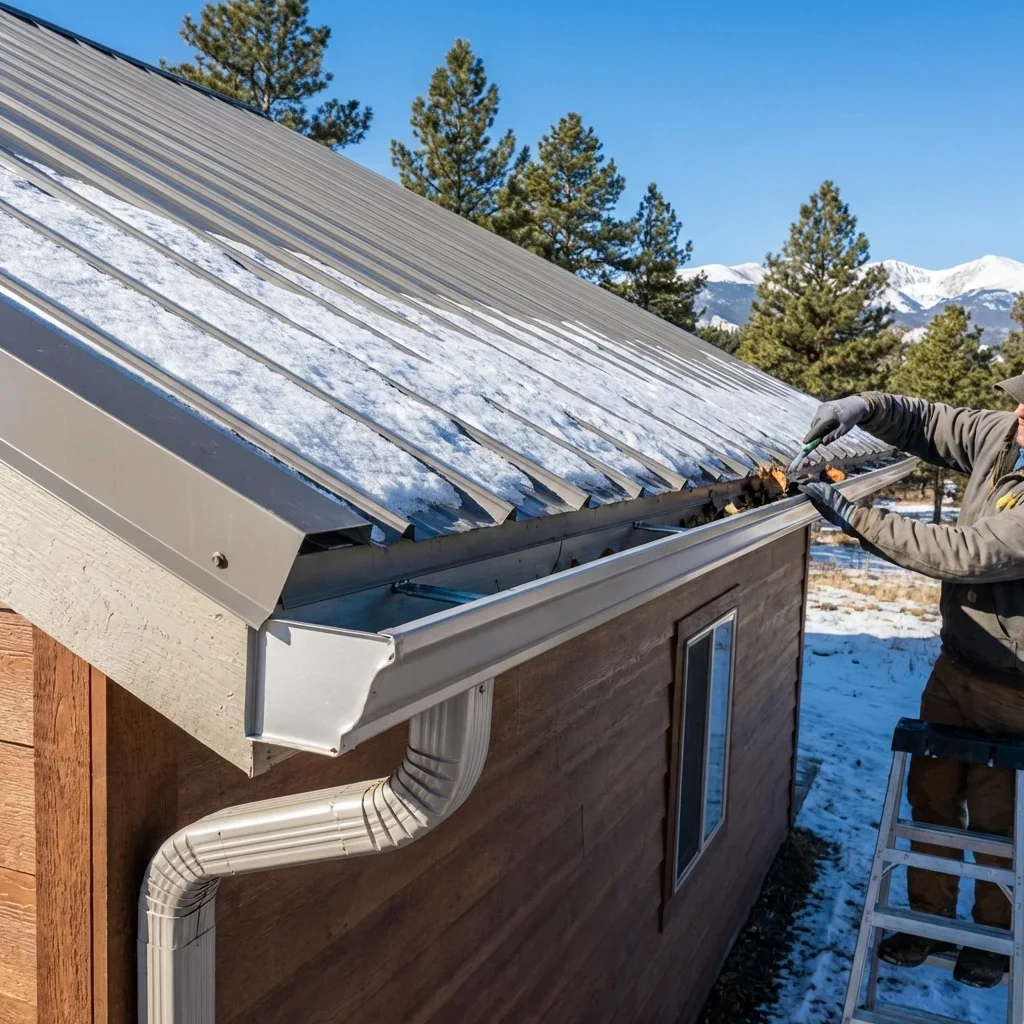
Clean gutters are critical for ice dam prevention. Clogged gutters trap water that freezes, creating an ice platform that extends ice dams further up the roofline.
Clean gutters in October and again in early December after leaves fall but before heavy snow arrives.
Gutter guards reduce maintenance but don't eliminate it. Pine needles, aspen leaves, and roof grit still accumulate. Micro-mesh gutter guards ($8-$15 per linear foot installed) work best in Colorado's climate, blocking debris while allowing water flow. Avoid reverse-curve systems and foam inserts, which perform poorly in freeze-thaw conditions.
Downspout Extensions and Drainage
Downspouts must discharge at least 6 feet from foundation walls to prevent basement water intrusion. That's particularly critical along the Front Range, where expansive clay soil traps water near foundations and causes heaving when it freezes.
Underground drainpipe connected to downspouts should daylight downslope or connect to storm drains, not dump water where it pools and freezes near the foundation.
If you notice ice buildup around downspout discharge points, extend drainage further from the house or add splash blocks that direct water away during thaw cycles. Pooled water near foundations refreezes nightly, creating hidden ice dams at ground level that contribute to basement flooding when spring runoff begins.
Finding Qualified Contractors in Colorado
Colorado does not require a state-level roofing contractor license, so you need to verify credentials at the municipal level. Denver, Boulder, Colorado Springs, Aurora, Fort Collins, and Lakewood all maintain separate contractor registration or licensing systems.
Check your city's building department website or verify at https://www.colorado.gov/dora for statewide professional licensing information.
Ask contractors for proof of general liability insurance ($1 million minimum) and workers' compensation coverage. Request references from ice dam remediation jobs specifically. Standard reroofing experience doesn't guarantee expertise in winter emergency work or steam melting equipment.
Storm Chaser Warning Signs
After major Front Range hail events, out-of-state contractors flood the market promising quick insurance claim approvals and free roof inspections. Many operate from hotel rooms with no local presence, collect insurance checks, and disappear before warranty issues surface.
Red flags include pressure to sign contracts immediately, offers to "eat your deductible" (insurance fraud), and reluctance to provide local references.
Work with contractors who maintain year-round Colorado offices, carry local business licenses, and offer roof maintenance programs that include post-winter inspections. Local contractors have reputations to protect and warranty obligations they can fulfill next year when you need service.
Mountain Home Specific Challenges
Homes above 8,000 feet face ice dam conditions for 4-5 months annually compared to 6-8 weeks at lower elevations. Sustained sub-freezing temperatures mean ice dams grow thicker and persist longer, increasing water intrusion damage.
Roof pitches in mountain communities often exceed 6:12 to shed snow, but steeper slopes create safety challenges for ice dam removal and make DIY approaches dangerous.
Building codes in Summit County, Eagle County, and mountain jurisdictions specify snow loads of 60-100+ PSF depending on elevation and terrain. Roof structures built to handle those loads cost more upfront, but ice dams on undersized roofs can cause structural failure when combined with heavy snow weight. If you're buying a mountain property, verify that roof framing meets current snow load calculations. Many 1970s-1980s cabins were built to outdated standards.
Seasonal Access and Contractor Availability
Mountain roofing contractors operate May through October for installations, with limited emergency service during winter. Ice dam removal and roof snow removal services book solid during heavy snow years, sometimes requiring 1-2 week wait times even for active leaks.
Keep a local contractor's emergency number on hand before winter starts, and consider pre-paying for priority service if you've had previous ice dam issues.
Contractors in Breckenridge, Vail, and Aspen charge premium rates ($150-$250/hour) for winter emergency calls due to difficult access and weather-dependent work windows.
Monitoring Your Roof Through Winter
Walk your property after each snowstorm to check for icicle formation along eaves. Small icicles indicate normal melt-freeze cycles, but continuous ice ridges 6+ inches thick signal developing ice dams.
Look for:
- Icicles forming in mid-roof sections rather than just at eaves (indicates melt from warm roof deck)
- Ice buildup behind gutter lines (shows blocked drainage)
- Snow melting on upper roof sections while eaves stay snow-covered (temperature differential problem)
- Water stains on soffits or fascia boards (early leak warning)
Catch ice dams early and you can clear roof snow before dams grow thick enough to force water under shingles. A roof rake costs $30-$60 and lets you pull snow off eaves from ground level after each storm.
Interior Warning Signs
Check attic spaces monthly during winter for frost buildup on roof deck undersides or wet insulation. Frost indicates warm humid air reaching cold roof surfaces — the same condition that melts roof snow and creates ice dams.
Wet insulation means water is already penetrating your roof assembly, requiring immediate investigation.
Ceiling stains near exterior walls, especially on upper floors, are the clearest sign of ice dam damage. Don't wait for active dripping. Stains show water has already saturated drywall and insulation. Schedule a roof inspection at the first sign of staining, even if the leak isn't active, so you can document damage and plan repairs before the next storm cycle.
Frequently Asked Questions
- City of Arvada, CO. "Re-Roofing Ice Dams Memo." https://www.arvadaco.gov/DocumentCenter/View/400/Re-Roofing-Ice-Dams-Memo-PDF?bidId=. Accessed April 08, 2026.
- Colorado Secretary of State / Department of Natural Resources, Division of Water Resources. "Code of Colorado Regulations: Rules and Regulations for Dam Safety and Dam Construction (2 CCR 402-1)." https://www.sos.state.co.us/CCR/GenerateRulePdf.do?ruleVersionId=8426&fileName=2. Accessed April 08, 2026.
- State of Colorado. "State of Colorado Dam Safety Manual." https://hermes.cde.state.co.us/islandora/object/co:3411/datastream/OBJ/download/State_of_Colorado_dam_safety_manual.pdf. Accessed April 08, 2026.