
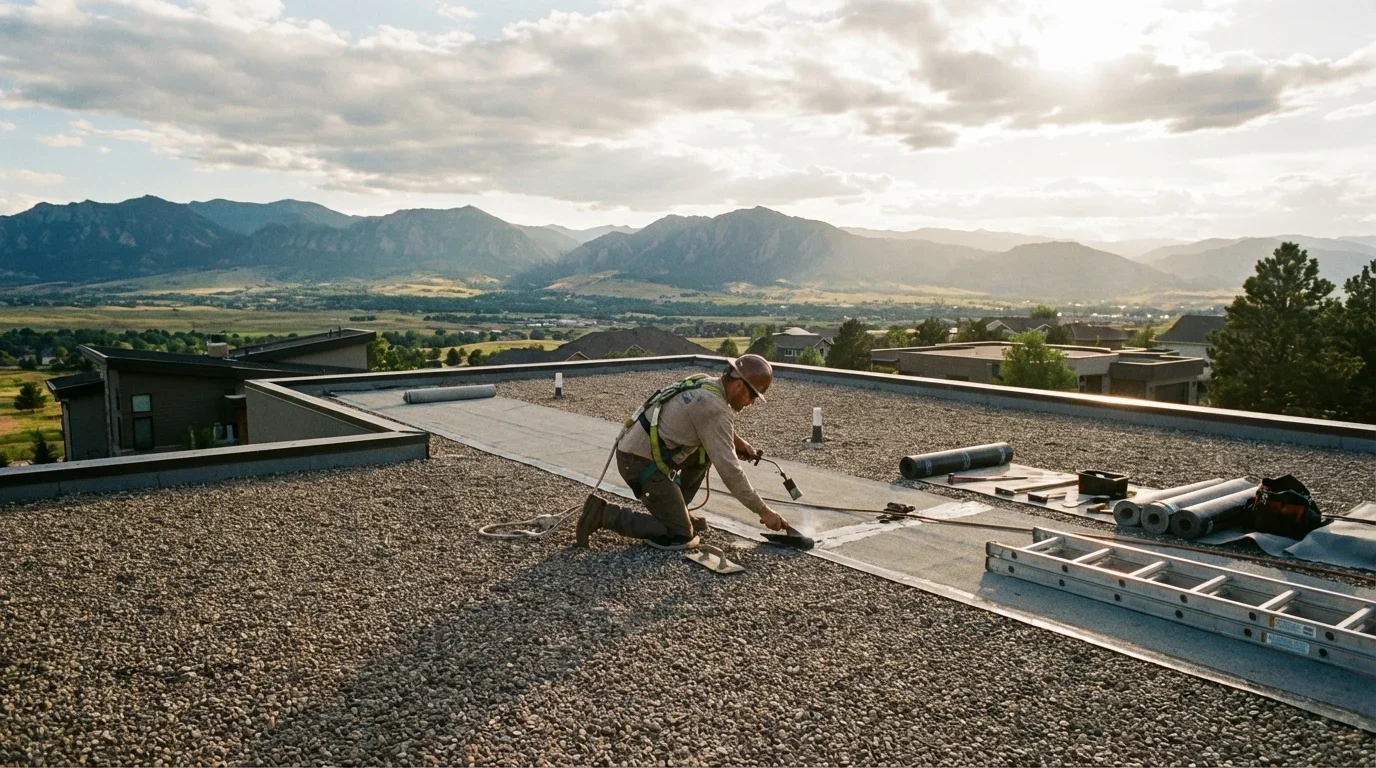
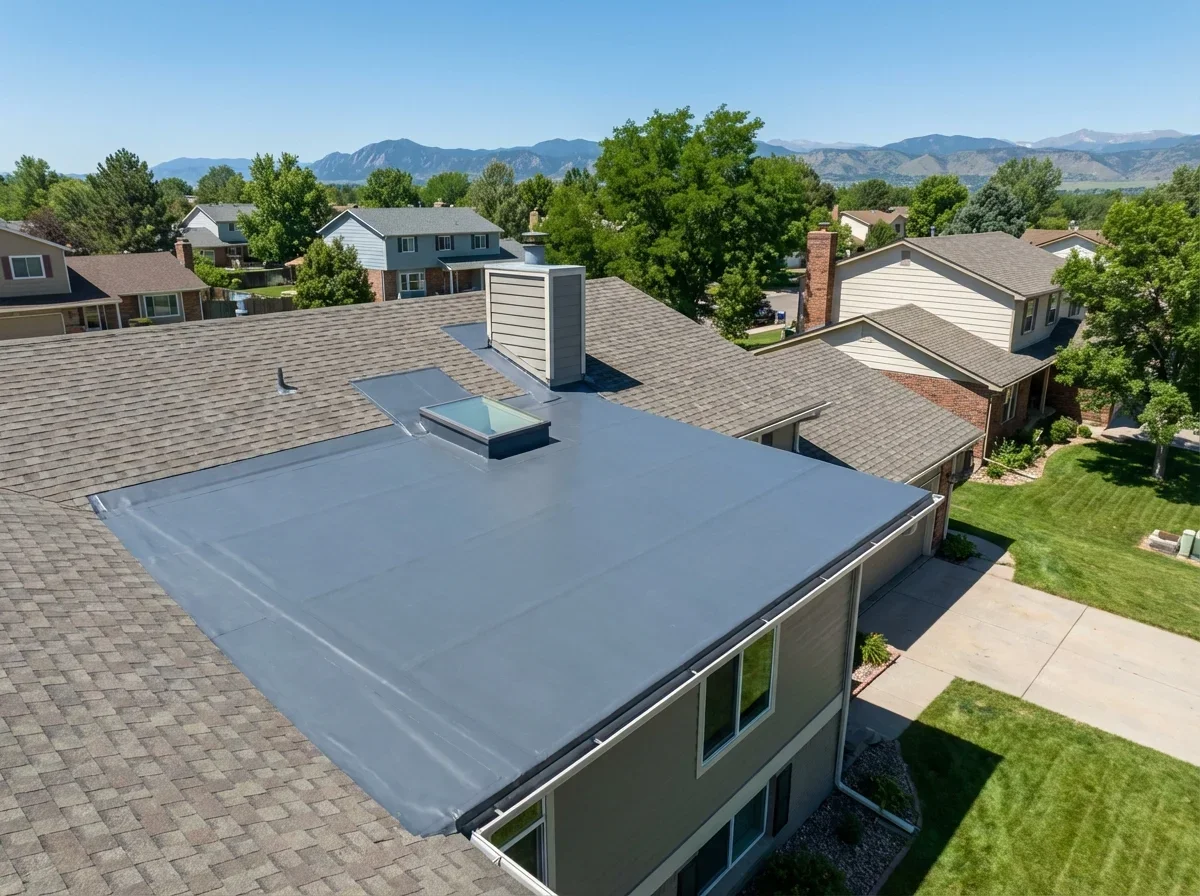
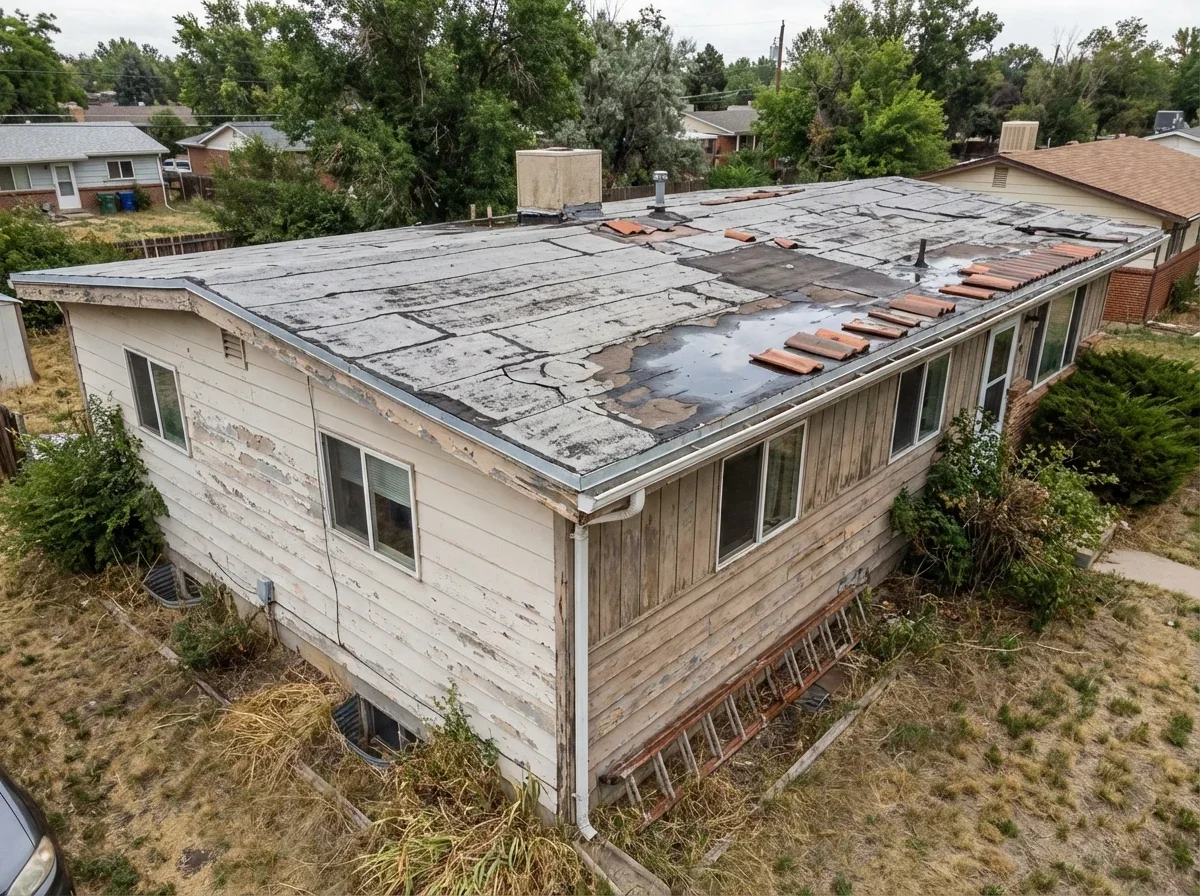
Flat roof repair requires specialized expertise to address ponding water, membrane damage, and seam failures common in Colorado's climate. Quick professional intervention prevents minor issues from becoming costly interior damage. Find qualified Colorado flat roof repair contractors who work with all membrane types and can diagnose problems unique to low-slope roofing systems.
Featured Contractors
View all →


When Do You Need Flat Roof Repair?
Your flat roof is signaling problems if you see water stains spreading across interior ceilings, blistering or bubbling membranes, exposed insulation through tears, or seam separation along welded joints. These aren't cosmetic issues — they're structural warnings.
Ponding water is the critical indicator. If water pools remain more than 48 hours after rain or snow melt, you're violating International Building Code drainage requirements and accelerating membrane deterioration.[1]
Colorado's freeze-thaw cycle creates unique damage patterns. When temperatures swing from 15°F overnight to 65°F by afternoon — common along the Front Range from Fort Collins through Denver to Colorado Springs — trapped moisture expands and contracts inside membrane layers. This cycling causes micro-cracks that become full tears within months.
After hail storms, inspect immediately. Golf-ball-sized hail (common in Thornton, Aurora, and Lakewood) punctures TPO and EPDM membranes on impact.
Waiting weeks to inspect means water intrusion spreads into insulation and decking, multiplying repair costs.
Catching membrane damage early prevents interior catastrophe. A $1,200 membrane patch beats a $40,000 ceiling replacement, mold remediation, and business interruption claim.
Emergency repairs are needed when active leaking occurs, metal flashings separate from parapet walls, or storm damage exposes roof decking. Scheduled preventive repairs handle blisters, minor seam degradation, and fastener back-out before they escalate.
What Does Flat Roof Repair Cost in Colorado?
Flat roof repair pricing depends on membrane type, damage extent, and accessibility. Colorado commercial buildings average $450-$1,200 per repair area, with costs escalating when structural work is required.
Colorado Commercial Flat Roof Repair Costs
| Repair Type | Typical Cost Range | Timeline |
|---|---|---|
| Single penetration patch (skylight, HVAC curb) | $450 - $850 | 1 day |
| Seam repair (10-20 linear feet) | $600 - $1,100 | 1-2 days |
| Blister repair (3-5 blisters, cut and patch) | $700 - $1,400 | 1-2 days |
| Section replacement (100-500 sq ft membrane + insulation) | $2,800 - $9,500 | 3-7 days |
| Ponding water drainage correction (tapered insulation) | $4,500 - $12,000 | 5-10 days |
Material costs vary significantly. TPO membrane repairs run 15-25% less than PVC due to simpler welding equipment. EPDM adhesive-bonded repairs cost less upfront but have shorter lifespans than heat-welded systems, making PVC the best long-term value despite 20-30% higher initial costs.
Key cost factors include roof accessibility (crane requirements add $800-$1,500), insulation replacement needs (wet insulation must be removed, adding $3-$6 per square foot), and emergency service premiums (after-hours rates run 50-75% higher).
Buildings in Boulder, Greeley, and Grand Junction with heavy snow loads often need structural reinforcement during repairs, adding $2,000-$5,000.
Permit costs matter. Repairs exceeding 100 square feet trigger permit requirements in Longmont and most Colorado municipalities, adding $150-$400 in fees and mandatory inspections.[1] Contractors without proper licensing face code violations — verify municipal permits before work begins.[3]
Insurance coverage for storm damage repairs varies. Hail damage claims typically cover membrane replacement, but ponding water failures (maintenance issues) are excluded. Most commercial policies require repairs within 60-90 days of damage discovery to maintain coverage.
Our Insurance Claim Assistance service helps document damage properly.
Return on investment is immediate. A $1,200 seam repair prevents $15,000-$40,000 in water damage to inventory, electronics, and ceiling systems. Buildings with documented preventive maintenance qualify for 10-15% lower insurance premiums.
How Flat Roof Repair Works
Proper flat roof repair starts with moisture scanning using infrared or nuclear density meters to map all wet insulation areas — not just visible damage. Colorado contractors inspect drainage patterns carefully since our daily temperature swings cause expansion joints to shift, creating low spots that violate the 48-hour drainage standard.
Repair Methods by Membrane Type
| Membrane Type | Repair Method | Durability After Repair |
|---|---|---|
| TPO | Heat-welded patches (400°F+ weld) | 15-20 years if properly welded |
| EPDM | Adhesive-bonded patches with primer | 10-15 years with UV-resistant adhesive |
| PVC | Chemical-welded patches (solvent fusion) | 20+ years, strongest bond |
The Repair Process
- Damage Assessment — Core samples verify insulation moisture levels; thermal imaging maps the full extent beyond visible damage
- Membrane Preparation — Cut away damaged sections 12" beyond visible failure; inspect substrate for wood rot or concrete deterioration
- Substrate Repair — Replace wet insulation (critical in Colorado's freeze-thaw zones); repair or reinforce roof decking
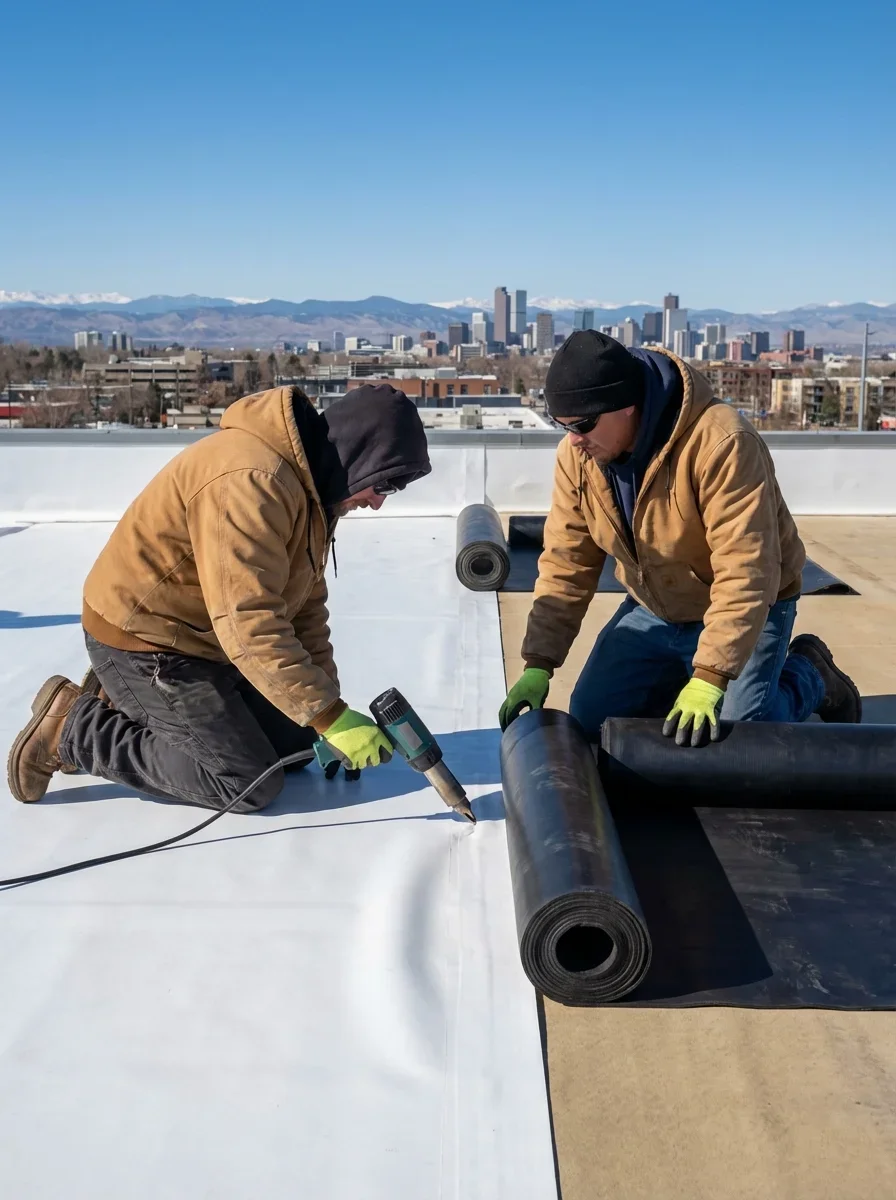
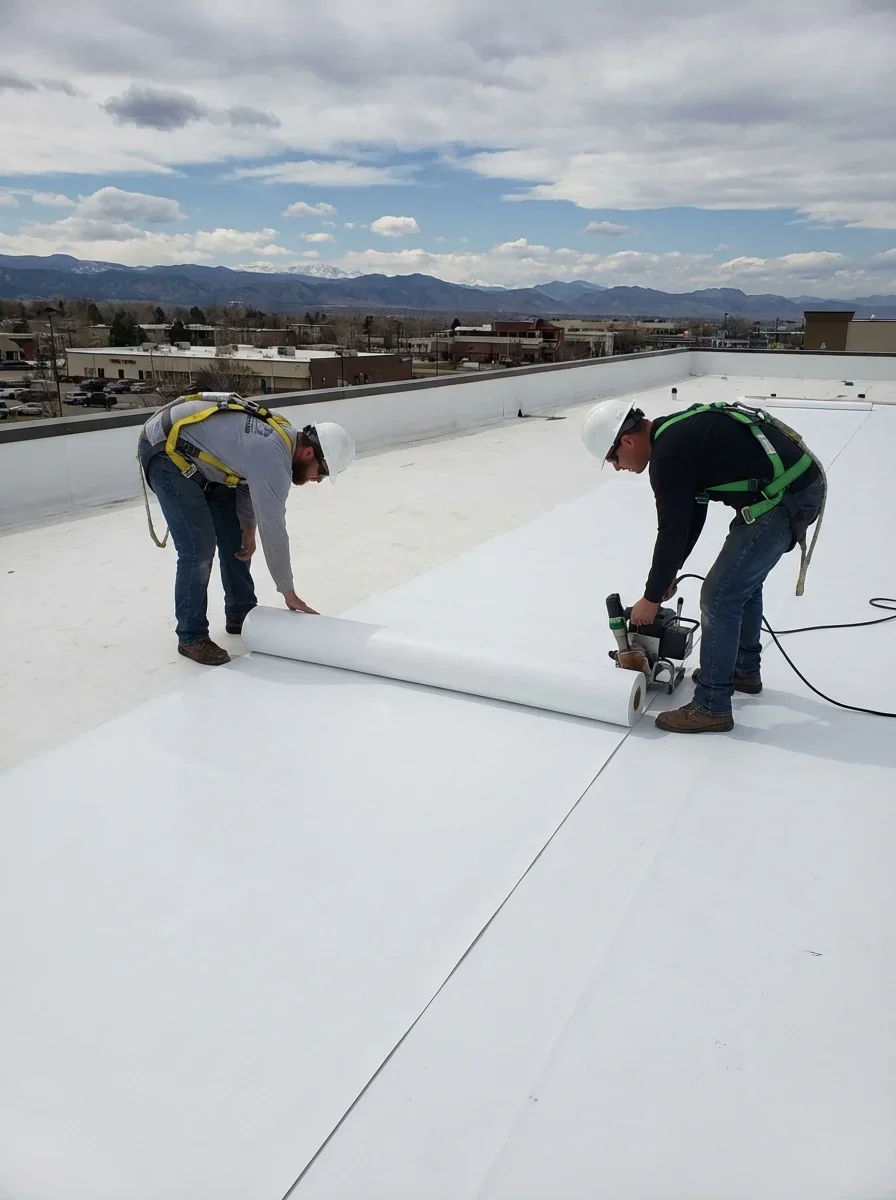
- Membrane Installation — Heat-weld TPO, chemically weld PVC, or adhesive-bond EPDM patches with 6" minimum overlap on all sides
- Seam Testing — Pull-test welded seams at 40+ pounds; flood-test repairs for 24 hours before sign-off
Most isolated repairs (single penetration leaks, small seam failures) complete in 1-3 days. Extensive membrane section replacements covering 500+ square feet require 5-10 days, especially when insulation replacement is needed.
In Colorado, schedule repairs during dry weather windows — avoid late October through March when snow accumulation and subfreezing temperatures prevent proper membrane adhesion.
Timing matters for code compliance. Denver requires pre-inspections before any commercial roof work begins, and repairs exceeding 200 square feet trigger full permit requirements.[2]
How to Choose a Commercial Flat Roof Repair Contractor
Colorado has no state-level roofing license, making contractor vetting critical. Municipal licensing requirements vary — Denver requires a Supervisor Certificate for commercial work, while other cities rely on general contractor licensing.
Questions to Ask Before Hiring
- What membrane certifications do your technicians hold? Demand manufacturer-certified installers for TPO (GAF, Firestone), EPDM (Carlisle, GenFlex), or PVC (Sika Sarnafil, Duro-Last) systems
- Do you carry commercial general liability insurance with minimum $2 million aggregate coverage? Verify certificate directly with insurer — standard $1 million policies are insufficient for commercial buildings
- Will you provide core samples and moisture mapping before quoting? Legitimate contractors never quote without subsurface inspection
- What's your warranty structure? Quality repairs include 5-10 year workmanship warranties plus manufacturer material warranties (10-20 years)
- How do you handle permit requirements? Contractor should obtain permits and schedule required inspections — you shouldn't manage this process
- What's your emergency response protocol? Commercial leaks need 24-hour availability with temporary waterproofing capability
Red Flags That Signal Problems
- Quotes without roof inspection or moisture testing (they're guessing)
- Pressure to authorize "emergency" full replacements for repairable damage
- No references from commercial property managers or building owners
- Unwillingness to provide manufacturer certifications or insurance certificates
- Cash-only payment terms or requests for full payment upfront
Colorado Roofing Association (CRA) membership indicates commitment to industry standards and continuing education. Check the CRA member directory and verify standing before signing contracts.
Start comparing Colorado-certified commercial roofing contractors now. Our directory connects you with membrane-certified professionals who carry proper commercial insurance and maintain municipal licensing. Filter by city, membrane expertise, and emergency availability to find qualified contractors in Pueblo, Longmont, or anywhere across the Front Range.
Frequently Asked Questions
- City of Longmont, Colorado. "Roofing Guidelines for Commercial and Residential Projects." https://longmontcolorado.gov/building-inspection/roofing-guidelines-for-commercial-and-residential-projects-1/. Accessed April 08, 2026.
- City and County of Denver. "Roofing in Denver." https://www.denvergov.org/content/dam/denvergov/Portals/696/documents/Other_forms_and_guides/1-31-17_Roofing_in_Denver.pdf. Accessed April 08, 2026.
- Pikes Peak Regional Building Department. "Roofing Guidelines." https://www.pprbd.org/File/ByAlias/ReroofGuidelines. Accessed April 08, 2026.
Related Articles
Need Help With Your Project?
Join 500+ homeowners we've helped